Writing down what I think about theatre I've seen in That London, whether I've been asked to or not.
Showing posts with label Caryl Churchill. Show all posts
Thursday, 29 August 2024
Radio review: Love and Information
Back to my occasional reviews of radio adaptations of stage work, where BBC Radio 3's recent production of Love and Information is the first audio adaptation, and 12 years seems like a surprisingly long time to wait to give it that treatment: After all, Caryl Churchill's 2012 play is an experiment in form that requires all kinds of resources for a live revival, that are a lot easier to get around on radio, where sketch shows are common. And that's essentially the format Churchill used for this play, whose cast very quickly run their way through more than a hundred characters in over fifty scenes that are rarely as long as two minutes, and can be as short as a single sneeze. As an audience member, one advantage this has is that I was able to focus entirely on the scenes and not the staging - I remember the original production at the Royal Court as being brilliant, but it was impossible not to be slightly distracted by the impressively slick scene changes.
Labels:
Alan Williams,
Caryl Churchill,
Danielle Vitalis,
Emma Fielding,
Joel MacCormack,
Jon Nicholls,
Josh Barrow,
Karl Johnson,
Kathleen Cranham,
Mary Peate,
Michele Austin,
radio,
Rosie Cavaliero,
Sam Swann
Thursday, 26 October 2023
Theatre review: Owners
I talk about Caryl Churchill being an outlier among playwrights, in that the older and more venerated she becomes, the shorter and more succinct her work gets. Does that mean going back to one of her first-ever plays will find her at her most rambling and unfocused? Well, yes as it turns out, but Owners, which Stella Powell-Jones revives at Jermyn Street, also shows her not only commanding some great dialogue, but also occasions when she seems decades ahead of her time. Right from the comic opening scene in fact, where Clegg (Mark Huckett) closes the doors for the last time on the butcher's shop he inherited from his father and hoped to pass on to his son. But his wife can't have children, and is such a high-flying success that she'll be the one supporting both of them from now on.
Monday, 4 October 2021
Theatre review: What If If Only
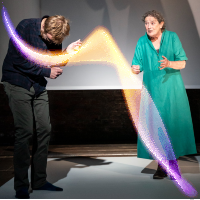
If Caryl Churchill's career wasn't already distinguished enough, in recent years it's also become notable for her work's increasing brevity - slowly but surely she's moving towards the point where she can emotionally devastate you in under a minute. What If If Only brings us to the 20-minute mark (positively epic compared to the 14 minutes originally advertised,) and it manages a feat that's both impressive and, annoyingly, virtually impossible to convey in a review: Being completely nebulous in its content, yet crystal clear in its intentions and emotional impact. In Churchill's surreal, political ghost story, Someone (John Heffernan) is at his dinner table mourning the loss of a loved one to suicide, still talking to them and wishing they could return. A ghost does materialise with some resemblance to the person he lost, but she's not quite right - she's older, like a future version who never got to exist.
Monday, 2 March 2020
Theatre review: A Number
A Number premiered in 2002, a few years after the Dolly the Sheep story and with the possibility and ethics of human cloning still a subject of much discussion. The amount of times it’s been revived since is a testament to the fact that Caryl Churchill created something out of that story that far transcends topical controversy, finding an enduring human side that Polly Findlay’s production at the Bridge explicitly focuses on. This is the third production of the play I’ve seen, and the first not to cast a real-life father and son, although Roger Allam and Colin Morgan have worked together in ersatz father/son roles before. And despite the genetic material there’s something ersatz about the father/son relationships they play out in A Number as well – I told the people I went to the show with to go in knowing as little about it as possible, and would recommend that to anyone planning on seeing it; in which case save this review until after you’ve been as well, as it’s a hard play to write about without major spoilers.
Tuesday, 25 February 2020
Theatre review: Far Away
The usual January trend of grim and serious shows has well and truly continued into February this year, but my diary's due to go into a period with a bit more light relief. Before it can though, a particularly disturbing dystopia - but as it's courtesy of Caryl Churchill, it comes to the stage with unusual flair and extraordinary succinctness, running well under an hour but creating whole worlds in that time. The final show in Michael Longhurst's first year at the Donald and Margot Warehouse is Lyndsey Turner's production of Far Away, which opens with a child, Joan (Sophia Ally or Abbiegail Mills,) unable to sleep on her first night staying at her aunt and uncle's house. Her aunt Harper (Jessica Hynes) tries to comfort her, and discovers that Joan's been disturbed by creeping out of bed at night and witnessing what happens in the shed, where several terrified adults and children have been brought for "processing."
Monday, 30 September 2019
Theatre review: Glass. Kill. Bluebeard. Imp.
Caryl Churchill’s later career has been typified by her enviable ability to make her point incredibly succinctly – her plays tend to be short and sharp, culminating in her writing Love and Information in the format of a sketch show. Her latest premiere at the Royal Court is a more loosely connected quadruple bill of plays: Glass. Kill. Bluebeard. Imp.’s stories are self-contained and varied in style, but all share a theme of deconstructing legends and fairytales, bringing the fantastical into an often comically banal light and finding the dark truth behind the magical fiction. Each play is slightly longer than the one before, so the first act consists of the first three stories, opening with Glass in which Kwabena Ansah, Louisa Harland, Patrick McNamee and Rebekah Murrell tell the story of a girl made of glass (Murrell,) trying to navigate her teenage years and a romance with a boy (McNamee) who may be as fragile as she is in his own way.
Thursday, 4 April 2019
Theatre review: Top Girls
Which five people, living or dead, real or fictional, would you invite to your dream dinner party? To most people that’s a creaky old conversation-starter, but to Marlene (Katherine Kingsley) it’s the perfect way to celebrate a promotion, in the famous opening act of Caryl Churchill’s Top Girls. It’s 1981, Marlene’s become the first female Managing Director of Top Girls Employment Agency, and she’s gone to a trendy restaurant with five women from history and legend who embody a female ideal - or at least someone’s idea of it. Victorian adventurer Isabella Bird (Siobhan Redmond) and 13th century Japanese concubine, Buddhist nun and author Lady Nijō (Wendy Kweh) made their own way in a man’s world while others, like Pope Joan (Amanda Lawrence) and Brueghel’s soldier-woman Dull Gret (Ashley McGuire) took on masculine roles, sometimes with tragic consequences.
Saturday, 22 October 2016
Theatre review: Blue Heart
Shopping and Fucking might be the most attention-grabbing title getting a 20th anniversary revival but, already long-established by the time Mark Ravenhill & co emerged, Caryl Churchill showed around the same time that she could more than match the new faces for experimentation in form - even if, like her more recent Escaped Alone, she does it with middle class ladies rather than sexually charged Gen X-ers. Blue Heart is in fact a double bill of short works that play around with, in the first instance form, and in the second case language. In Heart's Desire, Alice (Amelda Brown) and Brian (Andy de la Tour) are waiting for their daughter Susy (Mona Goodwin) to arrive from the airport; She emigrated to Australia and this is her first visit back. But the wait is infinitely prolonged because Churchill keeps taking the action back to the start, or to a particular point in the conversation.
Monday, 8 February 2016
Theatre review: Escaped Alone
Mrs Jarrett (Linda Bassett) is passing an open door in a garden fence when she peers
in and is invited - by someone who already seems to know her name - to join the
three other women in there for tea and a chat. Lena (Kika Markham) hasn't been
leaving the house, and the other women suspect she's not been taking her medication
properly. It's best never to mention cats in front of Sally (Deborah Findlay,) as it
upsets her (birds are fine, in fact they discuss birds a lot, as long as it doesn't
lead to talk of cats chasing them.) And Vi (June Watson) spent six years in prison for
accidentally-on-purpose killing her husband, after which her hairdressing career
never really recovered. Escaped Alone is Caryl Churchill's latest play and
the women's conversations are delivered in the minimal style she often employs -
exchanging only fragments of sentences but the meaning still managing to come across
clearly.
Wednesday, 9 December 2015
Theatre review: Here We Go
Caryl Churchill's certainly been very visible lately: Revivals of Light Shining in Buckinghamshire and A Number, a new play coming up at the Royal Court, and before
that "a short play about death," the variously lyrical and frustrating Here We
Go, directed by Dominic Cooke at the Lyttelton. Its three scenes appear to take
place in reverse chronological order, beginning at a funeral where mourners
including Joshua James, Amanda Lawrence, Alan Williams, Eleanor Matsuura and
Madeline Appiah exchange stilted snippets of conversation about the deceased,
platitudes about what a memorable character he was and how they can't quite believe
he's gone. But we also get a glimpse into their own mortality as each of them turns
to the audience to let us know when and how they will die (one will be run over the
very next day.) For the next scene we go back a bit to meet the deceased himself
(Patrick Godfrey,) moments after his death.
Thursday, 9 July 2015
Theatre review: A Number
Caryl Churchill's A Number seems to be a popular choice for real-life father/son acting teams to take on; a few years ago I saw Timothy and Samuel West play opposite each other at the Menier, and for the latest revival at the Young Vic John and Lex Shrapnel are the father/son team-up. Although it provides strong roles, especially for the son, it still feels to me a bit of an eccentric choice to show off the family dynamic, as it portrays an especially twisted relationship. (And if you're planning on seeing it I recommend not reading the rest of my review until afterwards, as discovering the nature of the relationship is one of the play's strengths.) As the play begins Salter (John) is confronted by his son Bernard (Lex,) who's just discovered the truth about himself: He is actually Bernard 2, a clone of the first son Salter lost in a car crash. In fact as it turns out he's only one of a number of clones, the scientists having made more than requested, so they could follow their lives and discover more about nature vs nurture. But there's a lesson in that much closer to home.
Tuesday, 28 April 2015
Theatre review: Light Shining in Buckinghamshire
Things would probably be better all round for everyone (especially me) if I could have made this a non-review, but while I was tempted, I didn't leave Light Shining in Buckinghamshire at the interval like so many people. It was probably more the fact that this is the inaugural production from the NT's new team in charge that brought me back, rather than any real faith that the second act might be better (it wasn't.) Caryl Churchill's 1976 play is a look at the English Civil War, specifically one side of it - the Levellers and the peasants who backed them up, ending up with the deposition and execution of Charles I, and the installation of Oliver Cromwell (Daniel Flynn.) Though all fighting on one side, their motivations, religious beliefs and what they ultimately expect from their rebellion vary wildly and, using in part edited transcripts of real debates, Churchill shows us, in great detail, the major and minor points on which they differed, and what they actually got in the end.
Friday, 14 November 2014
Theatre review: Far Away
This year's JMK Award-winner is Kate Hewitt, who directs Caryl Churchill's Far Away at the Young Vic's Clare. It's a fairytale nightmare that follows Joan, first as a child (Emilia Jones or Sasha Willoughby,) who on a visit to her aunt Harper's (Tamzin Griffin) farm witnesses something horrific in the stables. As an adult, Joan (Samantha Colley) gets a job creating elaborate hats alongside co-worker Todd (Ariyon Bakare.) Their work is creative and beautiful, but the hats serve a grotesque purpose. Finally we see Joan, Todd (now her husband) and Harper all together, trying to stay safe from an enemy with eyes and ears everywhere. But the trio are as suspicious of each other as they are of anyone outside their walls, and in a world where anyone and anything could be an enemy, and allegiances shift constantly, it's hard to even know which side you're on.
Monday, 1 April 2013
Theatre review: The Hospital at the Time of the Revolution
Caryl Churchill's The Hospital at the Time of the Revolution, based on Dr Franz Fanon's observations of the 1950s Algerian revolution, dates from 1972 but had never been performed before the Finborough added it to its Sunday-Tuesday repertory slot. The after-effects of torture are the play's focus, not just on the direct victims - indeed the only character actually to have been tortured is entirely silent, and played here by a disconcerting puppet - but on everyone who's come into any kind of contact with the violence. We're in a mental hospital during the uprising the colonial French resolutely refuse to call a war, and its resources are being stretched to breaking point by the influx of patients whom Fanon (Miles Mitchell) observes, mostly silently and without getting directly involved.
Monday, 17 September 2012
Theatre review: Love and Information
Nikki Amuka-Bird, Linda Bassett, Amanda Drew, John Heffernan, Paul Jesson and Amit Shah are among the cast of 15 for Caryl Churchill's latest play, Love and Information. Almost as if she'd seen the Royal Court Downstairs' flair in recent years for lightning-fast scene changes and wanted in on the action, Churchill gives us essentially a fast-paced sketch show format. On what looks like the same white box, endless configurations of people and settings appear, to perform vignettes no longer than a couple of minutes at most, some lasting only seconds; a couple of them with barely any dialogue. The significance of some of the scenes is occasionally hard to pinpoint but overall a picture builds up of information in modern life: The demand for it (the opening scene is of Shah demanding a secret from Amuka-Bird,) the overload of it (he soon regrets asking,) and where emotions and individuality fit into a world made up of endless streams of data, both useful and useless.
Subscribe to:
Posts (Atom)


