Writing down what I think about theatre I've seen in That London, whether I've been asked to or not.
Showing posts with label Bunny Christie. Show all posts
Monday, 27 October 2025
Theatre review: The Unbelievers
It's a bit too vague for me to put my finger on as a meme of the year, but I definitely feel like there have been a lot of shows recently where the overall tone has been at odds with the subject matter, but in a deliberate way that works surprisingly well. Nick Payne's return to the stage is one of the clearest examples of this: We can use the word "hysterical" to mean two very different things, and the way The Unbelievers applies it to the story of a traumatised mother is unexpected and unpredictable. FD Nicola Walker plays Miriam, whose 15-year-old son Oscar didn't show up at school one day, and was never seen again. Payne's story jumps backwards and forwards seven years, from the days shortly after the disappearance when the police are mobilising a task force, to the point where the rest of the family are trying to persuade her that holding a memorial for Oscar might be a good idea, and various moments in between.
Saturday, 25 March 2023
Theatre review: Guys & Dolls
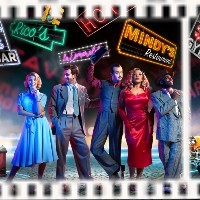
After successes with Julius Caesar and A Midsummer Night's Dream, Nicholas Hytner applies the Bridge Theatre's signature promenade staging to a musical for the first time. As classic Broadway musicals go, Frank Loesser (music & lyrics,) Jo Swerling and Abe Burrows' Guys & Dolls seems to be permanently ripe for revival - its last West End run was in 2015/16. Weaving together two of Damon Runyon's "Runyonland" short stories of petty crooks and gamblers in 1930s' New York, its central event is a floating craps game organised by Nathan Detroit (Daniel Mays.) With gambling illegal, a new venue has to be found every time to keep the police guessing, and the only spot available for tomorrow night's game will cost him $1000 up front.
Thursday, 16 December 2021
Theatre review: Best of Enemies

Apart from the occasional exception, James Graham is overwhelmingly known as a political playwright, often one who uses the past to illuminate the present, but even within those bounds there's a wide variety of styles he employs. His latest play does bring one very specific precedent to mind though: It could almost be a sequel to Ink, which pinpointed a particular moment in British newspaper history that changed the way political discourse and media influence would work right up until the present day. This time, the very topical issue is the abrasive and polarised style of political debate that fosters an almost tribal allegiance to extremes, and rejection of compromise. Inspired by Morgan Neville and Robert Gordon's documentary of the same name, Best of Enemies seeks the origin in American television, and the 1968 party conventions that would choose the Republican and Democratic candidates for the next election.
Wednesday, 16 June 2021
Theatre review: After Life
The Dorfman reopens with a Headlong co-production in which all the characters are dead. Arguably a questionable subject after the reason theatres were closed for so long in the first place, if it weren't for how charming and gently moving After Life proves to be. Designer Bunny Christie, director Jeremy Herrin and writer Jack Thorne are credited with co-creating the concept for a stage adaptation of a cult Japanese film from 1998, set entirely in a limbo that feels somewhere between a small office and a mid-range hotel (there is, unequivocally, no steam room.) Every Monday the Guides, led by Kevin McMonagle's phlegmatic line manager Five, meet a new group of the recently-deceased, or Guided. In private meetings they discuss happy, significant or otherwise precious memories from the life that just ended, and by the end of Wednesday the Guided need to have made an enormous, perhaps impossible decision.
Wednesday, 5 February 2020
Theatre review: The Welkin
After adapting Chimerica for TV Lucy Kirkwood returns to the stage for a play that feels equally epic in ambition, even if instead of spanning continents this one is largely set in a single room. It does have its thoughts on the stars though, as The Welkin takes place in Suffolk in 1759, the year in which Edmond Halley had predicted the comet that would eventually bear his name would appear. It's a scientific discovery that's captured the imagination of people even in remote, small towns like this one, with everyone regularly mentioning it, hoping they might catch a glimpse of the celestial body. But if human knowledge is expanding to include the heavens, women like midwife Lizzy Luke (Maxine Peake) find that progress closer to home is much slower than they would like. Summoned grudgingly away from her laundry, Lizzy's expertise has had her requested by a local judge to take part in one of the few areas of Georgian law left to the judgement of women.
Labels:
Aysha Kala,
Bunny Christie,
Cecilia Noble,
Hara Yannas,
Haydn Gwynne,
James Macdonald,
Jenny Galloway,
June Watson,
Lucy Kirkwood,
Maxine Peake,
Philip McGinley,
Ria Zmitrowicz,
Wendy Kweh
Thursday, 13 June 2019
Theatre review: A Midsummer Night's Dream
(Bridge Theatre)
About 25 years ago Adrian Noble’s A Midsummer Night’s Dream was one of a string of RSC productions that first inspired my love of theatre in general and Shakespeare in particular, and Anthony Ward’s design – the enchanted forest made entirely of a mismatched collection of light bulbs, umbrellas and wooden doors – cemented the way I see magic being created out of the purely theatrical. A cack-handed attempt at a screen adaptation means it’s probably not that fondly remembered any more, but it inevitably holds a special place for me. As one of the most popular Shakespeare plays I’ve seen many – too many – productions since, so while it’s hard to say if Nicholas Hytner’s pansexual, Cirque du Soleil-style Dream is flat out the best one I’ve ever seen (and in among the bad and average ones there’s been a lot I’ve really loved,) I can say that in that quarter of a century it’s the first one to send me out of the building with the same excited buzz and reinvigorated love of theatre as the first time.
Thursday, 11 October 2018
Theatre review: Company
Marianne Elliott’s production of Company has been a long time coming – tickets have been on sale for a year and a lot of excitement has been built up over Elliott’s twist to the famous 1970 musical: Stephen Sondheim and George Furth’s story of the one singleton in a friendship group full of couples has gender-flipped the lead, with a number of other characters either following suit, or having their roles mixed around a bit to suit the new premise. Bobbie (Rosalie Craig) is turning 35, and her friends are waiting at her apartment to throw a surprise birthday party; when she arrives they will inevitably keep bringing the subject round to her single status and asking when she’s going to get married. The show’s original working title was Threes, because that’s what Bobbie keeps finding herself in as her married friends invite her to be a third wheel and see how great coupled life is – something that’s not as convincing as they think it is.
Wednesday, 31 January 2018
Theatre review: Julius Caesar (Bridge Theatre)
Nicholas Hytner’s Bridge Theatre is intended to predominantly showcase new writing, but in only his second production there Hytner can’t resist going back to Shakespeare. This is in part because the opening season is also meant to show off the flexibility of the auditorium, and Julius Caesar is a play that lends itself to promenade staging, or in this case in-the-round staging with a section of the audience in promenade (of sorts.) Making the audience part of the action fills in the play’s reliance on crowds – whether as baying mobs, horrified onlookers, armies or, most crucially, the general populace of Rome in whose name the central characters act. Hytner’s production is modern dress, and David Calder’s Julius Caesar certainly has a visual nod to one current political figure as he shuffles onto the stage wearing a red baseball cap and revelling in the attention as much as anything.
Monday, 16 October 2017
Theatre review: Heisenberg: The Uncertainty Principle

Getting in on the Breaking Bad theme before Bryan Cranston himself arrives on the London stage, Marianne Elliott launches her new production company with Heisenberg: The Uncertainty Principle. But there's neither a real scientist nor a fictional drug kingpin to be seen because this is the latest play from Simon Stephens, a writer more than a little fond of cryptic titles whose connection to the subject matter is hard to pin down. 75-year-old butcher Alex (Kenneth Cranham) is minding his own business, listening to music on a bench in a train station, when 42-year-old American waitress Georgie (Anne-Marie Duff) kisses him on the back of the neck. She says she couldn't help it because he reminded her of her late husband, but she soon confesses that everything she said to him at first was a lie: She's actually a primary school receptionist who's never married but has a 19-year-old son, who's moved back to New Jersey to get away from her.
Wednesday, 28 June 2017
Theatre review: Ink
The more I think about Ink, the more overtly it seems like a take on Doctor Faustus. James Graham’s latest play – his first of three premieres over the next five months – is an origin story for the The Sun, Britain’s bestselling and most politically influential newspaper. The paper had already been running for a few years when we join the story in 1969, as an unloved stablemate of the bestselling Daily Mirror, with tiny sales figures and considered a bit of a Fleet Street joke, a job there even less in-demand than one in a local paper. Having already bought the Sunday paper News of the World, Australian businessman Rupert Murdoch (Bertie Carvel) doesn’t want his printing presses to go unused the rest of the week, and buys The Sun with a plan to turn it into a rival for The Mirror, and eventually overtake it. He courts Larry Lamb (not that one) (Richard Coyle) to be the first editor, responsible for finding that elusive mass appeal.
Tuesday, 18 October 2016
Theatre review: The Red Barn
After his transatlantic success in Ivo van Hove's A View From The Bridge, Mark Strong returns to the stage to work with a director who's always shown van Hove's influence in his work; but in Robert Icke's first production at the National, it's a legendary film rather than stage director who immediately comes to mind. David Hare's new play The Red Barn is an adaptation of crime writer Georges Simenon's novel La Main, taking place in the winter of 1968-69 in New England, where lawyer Donald Dodd (Strong) and his wife Ingrid (Hope Davis) have their friends Mona (Elizabeth Debicki) and Ray (Nigel Whitmey) visiting. On the way back from a party they get caught in a blizzard, and only three of them make it back to the house: Despite Donald going back out to search for him, Ray is never seen alive again. Although the storm causes a number of deaths, Donald's jittery behaviour makes this one seem particularly suspicious.
Thursday, 6 October 2016
Theatre review: The Tempest (Donmar King's Cross)
PREVIEW DISCLAIMER: I can't see any sign of the papers having been invited to this yet.
Phyllida Lloyd's all-female Shakespeare productions were announced as a trilogy, and the theme of "red hands" that ran through the other two plays made me think Macbeth might be the final bloody part. As it turns out Lloyd's idea was actually to do one tragedy - the original Julius Caesar - one history - the condensed Henry IV - and one comedy, which turns out to be The Tempest. As with the other two productions, the framing device is that Shakespeare's play is being staged by the inmates of a women's prison, a setting that would seem to lend itself better to the other two genres, but in fairness this is one of the comedies that's rarely actually funny. Instead the more accurate term of "late romance" would seem particularly appropriate here, as the prison story focuses even more on a character whose backstory has been becoming more prominent over the trilogy, and who of course is also the real-life company's big name: Hannah, the character Harriet Walter uses in the framing device, based on a real American lifer with no hope of parole.
Friday, 6 November 2015
Theatre review: Husbands & Sons
The National's new epic is called Husbands & Sons but it's the wives and
mothers - underappreciated and overbearing, respectively - who hold centre stage.
Ben Power adapts three DH Lawrence stories of a coal-mining town between Derbyshire
and Nottinghamshire in 1911, having them play out in parallel in a single
neighbourhood. Three houses are marked out on Bunny Christie's in-the-round set: At
the Holroyds', Lizzie (Anne-Marie Duff) is always saying she's finally had enough of
her husband Charles (Martin Marquez,) an angry drunk who's not above stumbling home
in the middle of the night with other women in tow. But she always takes him back,
despite the efforts of the plant's electrician Blackmore (Philip McGinley,) even when he reveals he's in love with her, and his plan to help her escape with him to Spain.
Wednesday, 2 September 2015
Theatre review: People, Places and Things
Emma (Denise Gough) is an actress who, halfway through a performance of The Seagull, loses sight of the difference between herself and her character, forgets her lines and is soon collapsing onstage. There's a prosaic reason for this blurring of identity: Emma is an alcoholic and addicted to various - mostly prescription - drugs, and soon she's checking herself into a rehab centre. The physical withdrawal is traumatic but over comparatively quickly, but what she finds the hardest is the the next part of her treatment, when in group therapy she's asked to reveal something of her true self and prepare to go back out into the world. The latest collaboration between the National Theatre and Headlong, and the first since both companies got new artistic directors, Duncan Macmillan's People, Places and Things attempts to shed a tragicomic light on the subject of addiction.
Saturday, 14 March 2015
Theatre review: Closer
It's a busy year for Patrick Marber - he's got two shows coming up at the National, not to mention constantly turning up on celebrity editions of Only Connect, despite appearing to have no idea how the game worksPUSHING THE BUZZER MEANS YOU HAVE TO ANSWER THE QUESTION, IT DOESN'T GIVE YOU AN EXTRA COUPLE OF MINUTES TO CHAT ABOUT IT. You know Victoria Coren-Mitchell wouldn't stand for that shizzle if it wasn't for charity. Meanwhile, David Leveaux revives Marber's misanthropic four-piece Closer at the Donmar Warehouse. Obituary writer and failed novelist Dan (Oliver Chris) has been going out with the much younger, ex-stripper Alice (Rachel Redford) for a couple of years when he meets, and instantly falls for, photographer Anna (Nancy Carroll.) When she rejects him Dan vindictively sets her up with a horny dermatologist he finds in a sex chatroom.
Thursday, 6 November 2014
Theatre review: Made in Dagenham
The film-to-musical adaptation has well and truly become a West End fixture, but when the end result is as fresh and downright eccentric as Made in Dagenham, it's clear there's a labour of love involved, not just a cynical recycling of a familiar property. The story of the 1968 strike by female workers at the Ford plant in Dagenham now has a book by Richard Bean, music by David Arnold and lyrics by Richard Thomas, and gets a typically inventive debut production from Rupert Goold. Gemma Arterton plays Rita, who works as a machinist sewing chair covers for Cortinas. As part of a larger deal with management, the workers' union has agreed that this job can be downgraded to "unskilled" and, reluctantly at first, Rita joins in the talks to get their pay grade back. But even if the women's skill is recognised, they will still earn significantly less than men on the same grade, so she aims higher: The women's demands have now changed to equal pay with the men.
Wednesday, 15 October 2014
Theatre review: Henry IV (Donmar Warehouse)
Following 2012's Julius Caesar, which saw the inmates of a women's prison perform the play but find some of its themes too close to home, for the Donmar's 2014 Shakespeare production they've returned to Phyllida Lloyd's concept to see the prisoners try again. Lloyd has now said she enviasages these all-female Shakeaspeares as a trilogy; the third play hasn't been revealed yet but the middle installment is a merging of the Henry IV plays. Although in practice it's a shortened version of Part 1, with Part 2 represented by its two most iconic scenes, plus a third that mops up some plot points. So this is largely the story of Prince Hal (Clare Dunne,) his life of petty crime and carousing with drunken knight Falstaff (Ashley McGuire,) and the first major indication that he's more of a formidable figure than he chooses to present: An uprising against his father, led by the charismatic Hotspur (Jade Anouka,) is crushed partly due to Hal's unexpected transformation into a fighting machine.
Wednesday, 9 July 2014
Re-review: The Curious Incident of the Dog in the Night-Time
If you don't know the plot of Mark Haddon's The Curious Incident of the Dog in the Night-Time, or anything about the adaptation by Simon Stephens and Marianne Elliott's hit production, you can read my previous reviews from when it ran at the Cottesloe and the Apollo, to get up to speed. The latter run came to an abrupt end when the ceiling fell in, but after a 7-month hiatus it's back, crossing the road to the Gielgud. It's not a desire to see the show in every theatre it sets up camp in that brought me back a third time (I won't be following it around on its upcoming tour or to Broadway, I'm not a crazy person.) It was rather the second major cast change that made me want to witness its return. Not just Graham Butler as the painfully literal-minded protagonist Christopher Boone, but Nicolas Tennant as his father Ed also seemed like perfect casting.
Thursday, 12 December 2013
Theatre review: Emil and the Detectives
It's a Moppets Christmas Carol in the Olivier this year where the National, usually preferring to cast adults as children for its big family shows, has taken its cue from the likes of Billy Elliot and Matilda and put a lot of faith in child actors. Many, many child actors. Many. Adapted by Carl Miller from the book by Erich Kästner, Emil and the Detectives is a story of Germany in 1929, meaning that right from the word go there's an edge to the show for the benefit of the adults, even as the kids get a story to get excited about. Emil (Toby Murray tonight, alternating with Ethan Hammer and Daniel Patten) has been trusted by his mother (Naomi Frederick) to go on the train alone, to visit his grandmother in Berlin and deliver her an envelope full of cash. When it goes missing, Emil decides to track down the thief, a notorious bank robber, with the help of the Detectives: The many, many children from all walks of life keen for an adventure. Many.
Wednesday, 17 April 2013
Theatre review: Children of the Sun
Howard Davies directing a Russian play has become a bit of an annual National Theatre tradition, often in a translation by Andrew Upton. This year they tackle Maxim Gorky, and his 1905 look at young intellectuals in a safe bubble that won't last forever, Children of the Sun. Protasov (Geoffrey Streatfeild) is head of a family that's owned much of their small town for decades - although their finances aren't quite what they used to be, perhaps in part due to Protasov's occupation: A scientist, he spends his days in a home laboratory doing chemical experiments that seem to require constant supplies. His sister Liza (Emma Lowndes,) who suffers from an unspecified illness, is regularly rejecting the advances of family friend and local vet Boris (Paul Higgins.) His wife Yelena (Justine Mitchell) is spending all her time with artist Vageen (Gerald Kyd.) And Protasov himself is the unwilling target of romantic advances from Boris' sister Melaniya (Lucy Black.)
Subscribe to:
Posts (Atom)


