Writing down what I think about theatre I've seen in That London, whether I've been asked to or not.
Showing posts with label Kevin McMonagle. Show all posts
Friday, 16 June 2023
Theatre review:
When Winston Went to War With the Wireless
There's a tendency for previously obscure ideas or stories to get multiple interpretations all at once. Sometimes the coincidence just seems random, at others there's an obvious logic to it: You can see why events of recent years might inspire multiple writers to look back at a historical event when a Conservative government attempted to control the output of the BBC. Six months ago I'd never heard of the feud between Winston Churchill and the BBC's first Director General, John Reith. Then earlier this year I listened to a radio drama about the subject, and within weeks it had been announced that Jack Thorne would be premiering his own take on the subject at the Donald and Margot Warehouse. Having been left with altogether too many W tiles, Thorne presents When Winston Went to War With the Wireless.
Saturday, 24 September 2022
Theatre review: I, Joan
On to my third play in a row with trans and non-binary themes, and by far the most high-profile: Charlie Josephine's I, Joan garnered angry and entirely predictable criticism long before anyone had seen it, once it was revealed that Joan of Arc would be portrayed using they/them pronouns*. Obviously, the idea that a woman who chose to die rather than wear a frock might have been less than 100% femme is a bit of a leap, but let's suspend disbelief for a bit shall we? Joan's story, from illiterate peasant girl, to unlikely military leader, to 14 seasons of Knots Landing, to martyrdom and finally becoming a patron saint of France, has been told on stage many times, and apart from a few speeches that directly address the play's take on gender, Josephine follows the familiar story beats: France has been beaten down by England, and Charles the Dauphin (Jolyon Coy) has been disinherited from his position as heir to the throne.
Thursday, 16 December 2021
Theatre review: Best of Enemies
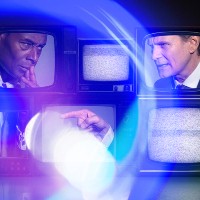
Apart from the occasional exception, James Graham is overwhelmingly known as a political playwright, often one who uses the past to illuminate the present, but even within those bounds there's a wide variety of styles he employs. His latest play does bring one very specific precedent to mind though: It could almost be a sequel to Ink, which pinpointed a particular moment in British newspaper history that changed the way political discourse and media influence would work right up until the present day. This time, the very topical issue is the abrasive and polarised style of political debate that fosters an almost tribal allegiance to extremes, and rejection of compromise. Inspired by Morgan Neville and Robert Gordon's documentary of the same name, Best of Enemies seeks the origin in American television, and the 1968 party conventions that would choose the Republican and Democratic candidates for the next election.
Wednesday, 16 June 2021
Theatre review: After Life
The Dorfman reopens with a Headlong co-production in which all the characters are dead. Arguably a questionable subject after the reason theatres were closed for so long in the first place, if it weren't for how charming and gently moving After Life proves to be. Designer Bunny Christie, director Jeremy Herrin and writer Jack Thorne are credited with co-creating the concept for a stage adaptation of a cult Japanese film from 1998, set entirely in a limbo that feels somewhere between a small office and a mid-range hotel (there is, unequivocally, no steam room.) Every Monday the Guides, led by Kevin McMonagle's phlegmatic line manager Five, meet a new group of the recently-deceased, or Guided. In private meetings they discuss happy, significant or otherwise precious memories from the life that just ended, and by the end of Wednesday the Guided need to have made an enormous, perhaps impossible decision.
Tuesday, 24 November 2015
Theatre review: The Divided Laing, or, The Two Ronnies
The psychiatrist RD Laing's theories were a major influence on Equus, so I was
interested in seeing a play about the man himself. Laing's work is now widely
discredited but Patrick Marmion's The Divided Laing, or, The Two
Ronnies takes place in 1970, when Ronnie Laing (Alan Cox) is in his prime: A
minor celebrity thanks to regular appearances on BBC2, and running his own mental
institution-cum-hippie commune, The Philadelphia Association. There the line between
doctors and patients is hard to see: Aaron (Kevin McMonagle) is his
long-standing colleague and the sensible balance to Laing's excess; also there is the intermittently American psychiatrist Joe (James Russell,)
and Mary (Laura-Kate Gordon,) the resident nurse, who may or may not have got
over her coprophilia. But Laing seems to identify most with David (Oscar Pearce,) a
South African with a voracious appetite for drink and drugs, who has to be kept in a
medically-induced coma much of the time.
Wednesday, 2 September 2015
Theatre review: People, Places and Things
Emma (Denise Gough) is an actress who, halfway through a performance of The Seagull, loses sight of the difference between herself and her character, forgets her lines and is soon collapsing onstage. There's a prosaic reason for this blurring of identity: Emma is an alcoholic and addicted to various - mostly prescription - drugs, and soon she's checking herself into a rehab centre. The physical withdrawal is traumatic but over comparatively quickly, but what she finds the hardest is the the next part of her treatment, when in group therapy she's asked to reveal something of her true self and prepare to go back out into the world. The latest collaboration between the National Theatre and Headlong, and the first since both companies got new artistic directors, Duncan Macmillan's People, Places and Things attempts to shed a tragicomic light on the subject of addiction.
Sunday, 7 September 2014
Theatre review: The Flouers o'Edinburgh
The Finborough is, surprisingly enough, the only London theatre to be marking the upcoming independence referendum in Scotland. It does so with the mini-season Scotland Decides/Tha Alba a'taghadh 2014, which has as its centrepiece a comic look at the social consequences of merging two nations who'd spent much of their history at war. First seen in 1948, Robert McLellan's The Flouers o'Edinburgh is set among the noble, if not as well-off as they used to be, denizens of Georgian Edinburgh. Girzie (Jenny Lee) has lost her lands and fortune, but finds solace in fiery niece Kate (Leigh Lothian.) Forbidding herself from marrying her good friend Sir Charles (Kevin McMonagle) until her brother returns from the army, Girzie puts her efforts intsead into finding a husband and stability for Kate. Sir Charles' son seems a perfect candidate, as he and Kate were good friends as children.
Tuesday, 12 June 2012
Theatre review: Twelfth Night (RSC / RST & Roundhouse)
It feels like so long since I saw a good Twelfth Night (the last one I really enjoyed was Michael Grandage's Donmar West End production in 2009) that I was starting to wonder if I'd completely imagined ever liking the play. So I was hoping for something special from David Farr's production for the RSC, currently visiting the Roundhouse as part of the "What country friends is this?" season. In rep with The Comedy of Errors and The Tempest, they're also calling the season Shakespeare's Shipwreck Trilogy (the RSC having realised Shakespeare wrote a shipwreck trilogy only after originally announced plans to include Pericles in the season got quietly shelved.) This particular shipwreck brings twins Viola and Sebastian to Illyria, here a dilapidated hotel in Greece in Jon Bausor's design. Each thinking the other drowned, Viola pretends to be a boy, and gets caught in the love games between the Duke Orsino (whom she has recently fallen for) and the disinterested object of Orsino's affection, Olivia, who now takes a shine to the "boy" Viola.
Subscribe to:
Posts (Atom)


