Writing down what I think about theatre I've seen in That London, whether I've been asked to or not.
Showing posts with label Philip Cumbus. Show all posts
Saturday, 18 October 2025
Theatre review: Cyrano de Bergerac
My last encounter with Edmond Rostand's Cyrano de Bergerac was Jamie Lloyd's rap battle reinvention, a version that won't be forgotten in a hurry. But while Simon Evans' production for the RSC is more traditional - nose and all - it proves striking and emotional in its own way. Adrian Lester plays Cyrano, who leads a troop of 17th century French army reserves, and is a curious mix of extremes. He's confident to the point of arrogance in his abilities both with a sword and with words, and with good reason: He can fight off a hundred men at a time, or take a man down in verbal combat instead. He's as likely to do either to any man who dares mention his unusual appearance, the reason for the contrasting, wildly insecure side of his personality: Since childhood he has been bullied for his unusually large nose.
Sunday, 4 June 2023
Theatre review: The Comedy of Errors (Shakespeare's Globe)
Sean Holmes liked a touch of European avant garde theatre when he was running the Lyric Hammersmith, and since coming to Shakespeare's Globe he's been responsible for some of the more eye-catching high-concept productions there, but this year he gets the tights and codpieces of the more "heritage" shows for The Comedy of Errors. There's also a hint of Les Misérables as the show opens, with flag-waving and singing about how great Ephesus is, and how they've fought back against the injustices done to them by Syracuse, with a hostile environment (/automatic death sentence) for any Syracusians who wash up on their shores. This is bad news for a number of the characters, but particularly Egeus (Paul Rider,) who's the only one to get caught. Egeus was shipwrecked while searching for his long-lost identical twin sons, and their identical twin servants.
Sunday, 29 May 2022
Theatre review: Much Ado About Nothing (Shakespeare's Globe)
2022's ubiquitous Shakespeare is the much-loved but problematic Much Ado About Nothing, and for my second major production of the year (and the first I've actually managed to get to in person) it's Lucy Bailey's return to Shakespeare's Globe. And groundlings will be pleased to know that this time she's embraced the venue's tradition of gently teasing and playing with the standing audience members, rather than actively trying to kill them. Joanna Parker's design keeps the Italian setting and moves it to 1945; the company's regular singing of "Bella Ciao" reassures us the soldiers at the heart of the story were anti-fascist rebels (or just big Money Heist fans.) After their victory, Don Pedro's (Ferdy Roberts) battalion retire to the estate of Leonata (Katy Stephens,) where two of Pedro's soldiers will find romance with major obstacles: In Benedick's (Ralph Davis) case a classic love/hate rom-com, but in Claudio's (Patrick Osborne) something more sinister.
Friday, 5 May 2017
Theatre review: The Resistible Rise of Arturo Ui
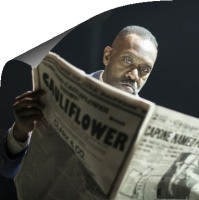
In one of the complete restructurings of the Donald and Margot Warehouse auditorium that have been an occasional theme during Josie Rourke's tenure, Peter McKintosh has added an extra row of seats to make the circle in-the-round, and removed all the stalls seating, to be replaced by tables and chairs all around the stage. It transforms the venue into a Prohibition-era Chicago speakeasy for Simon Evans' production of Brecht's The Resistible Rise of Arturo Ui, about a man seen as a joke, rising to great power and bringing destruction in his wake. Arturo Ui (Lenny Henry) is a lumbering, awkward gangster who chances upon some dirt on the powerful Dogsborough (Michael Pennington,) and blackmails his way into the city's cauliflower trade. With the success of his protection racket over the vegetable market, Ui takes acting lessons to disguise his awkwardness and make him a better public speaker, and his new mix of threats and rhetoric starts to build a following.
Wednesday, 2 November 2016
Theatre review: Comus
It's a strange time to see the start of a new Globe season, given all the current
sound and fury over Emma Rice's premature departure (personally I'm sure the
situation is far more complex than it initially appeared, but I think the board's
official statement suggesting they're now interfering directly in artistic policy
was disastrous, whether that's literally true or just a badly-worded press release.)
Still, for the couple of remaining seasons we will be seeing Rice in charge,
it's starting to look as is there's a theme to what'll end up on the Swanamaker
stage: Weird shit, possibly involving Philip Cumbus. For the first time the venue
attempts to recreate one of the elaborate masques that were a private treat for the
upper classes, with John Milton's Comus: A Masque in Honour of Chastity. As
the subtitle suggests, this is a rather po-faced morality tale, but that's not quite
what director Lucy Bailey puts on stage.
Wednesday, 7 September 2016
Theatre review: The Inn at Lydda
Although the initial description didn't instantly grab me, I eventually booked for
The Inn at Lydda based on the cast - not only a strong cast but one largely
made up of faces familiar to the Globe, suggesting that the new regime doesn't
entirely want to burn bridges with the old one (something tricky to do anyway
in the Swanamaker, where Dominic Dromgoole's face is part of the decor.) John
Wolfson's play, getting a short run in the indoor playhouse, imagines a meeting in
ancient Judea: The Emperor Tiberius Caesar (Stephen Boxer) is sick and dying, but
has heard of a miracle worker in a distant part of his empire, who he's sure can
cure him. Unfortunately by the time he and his entourage make it to Jerusalem, Jesus
of Nazareth has been crucified by Rome's own representatives. But unlike the last version of the story we saw on a London stage, this one is based on Christian
apocrypha, so the story doesn't end there.
Tuesday, 7 July 2015
Theatre review: The Importance of Being Earnest
Productions of The Importance of Being Earnest aren't exactly a rarity - in fact the last West End outing was only a year ago, and it didn't even do particularly good business. So it's a show I don't feel compelled to catch any given production of as the next one will be along soon enough. But I last saw it at the Old Vic, which a quick google reveals to have been twenty years ago, so I figured it was time to give it another go in Adrian Noble's production, which has settled into the Vaudeville for the summer. There's famously far too many roles available for older women - it's something like that, right? - so David Suchet has stepped in to ease the workload by taking on the role of Lady Bracknell, the archetypal formidable aunt. In another outrageous bit of casting, the show also stars Philip Cumbus, meaning not only is he missing a Globe summer season in an odd-numbered year for the first time since his first season in 2007, he's also missing his beard.
Thursday, 30 October 2014
Theatre review: 'Tis Pity She's a Whore
I'm reading A Game of Thrones at the moment, so blond siblings shagging each other is something of a theme as I get to the Swanamaker, whose first full winter season opens with 'Tis Pity She's a Whore. John Ford's tragedy sees a number of suitors wooing the wealthy and beautiful Annabella (Fiona Button,) who has little time for any of them. That's because her interests lie elsewhere, with her own brother Giovanni (Max Bennett.) When he admits he feels the same way, the two start a torrid and, of course, secret affair. Annabella continues to turn away her suitors, until she discovers she's carrying her brother's baby, and quickly consents to marry Soranzo (Stefano Braschi.) The deceit can't last long though, and with Soranzo having a few skeletons in his own closet, a traditional Jacobean bloodbath can't be far off.
Wednesday, 16 July 2014
Theatre review: Richard III (Trafalgar Studios)
Jamie Lloyd opens the second season of Trafalgar Underwhelmed Transformed like the first, with a big-name star in a popular Shakespeare play. Martin Freeman is Richard III in a production that takes its visual cue from the other famous Winter of Discontent, and sets the action in the late 1970s. In a drab Government office, Edward VI (Paul McEwan) has won - so far - the War of the Roses, but his health is rapidly failing. He has an heir, but his youngest brother Richard (Freeman) fancies the crown for himself. His plots quickly despatch middle brother Clarence (Mark Meadows) and with Edward's death he gets himself installed as Lord Protector over the underage prince. With a gift for manipulation, no qualms about bumping off half the court, and a number of supporters hoping to get a slice of power if he succeeds, he soon steps over his nephews to claim the throne himself.
Saturday, 5 October 2013
Theatre review: The Lightning Child
Euripides' The Bacchae features an antagonist threatened by sexuality, particularly that of women, whose plan to defeat this perceived threat involves him dressing as a woman himself. Throw in that popular Greek tragedy mainstay, the hermaphrodite seer Teiresias (Bette Bourne,) and it's not hard to see why it might have something to say to transgender people to this day, and be ripe for adaptation. Hence The Lightning Child, the final new premiere of the season at Shakespeare's Globe, and the latest collaboration between Ché Walker (book and lyrics) and Arthur Darvill (music and lyrics.) A disco-infused musical adaptation of the gory classic, The Lightning Child opens with Neil Armstrong (Harry Hepple) being cautioned by his wife that his planned mission is hubristic. Armstrong, of course, goes anyway, and in a scene left out of the history books encounters the man in the Moon, aka the Ladyboy Herald (Jonathan Chambers.) An acolyte of Dionysus, the Herald tells the astronaut of another case of hubris that upset the god.
Labels:
Arthur Darvill,
Bette Bourne,
Cat Simmons,
Ché Walker,
Clemmie Sveaas,
Colin Ryan,
Euripides,
Finty Williams,
Harry Hepple,
Jess Murphy,
Jonathan Chambers,
Matthew Dunster,
Moyo Akandé,
Philip Cumbus
Tuesday, 24 September 2013
Theatre review: Macbeth (Shakespeare's Globe)
Like many an actor, Eve Best wants to branch out into directing, and following her Beatrice at Shakespeare's Globe she'd had discussions about making that the venue for her directing debut. Apparently she'd imagined being given one of the comedies so when Dominic Dromgoole offered her Macbeth it was a surprise, but one she's embraced - although her interest in staging something lighter in the space is always apparent. It's only three years since the Globe staged Macbeth, in Lucy Bailey's production that embraced the play's dark magic to the point of revealing it as a Faustian story, complete with design straight out of Dante's Inferno. With that in recent memory it's wise of Best to go in a different direction, and she certainly does, making this one of the lightest takes on the play you're likely to see in a long while, embracing the surprisingly frequent opportunities for comedy, and she succeeds just about as well as it's possible to with this interpretation - though it's one with inherent problems.
Labels:
Bette Bourne,
Billy Boyd,
Cat Simmons,
Eve Best,
Gawn Grainger,
Harry Hepple,
Jess Murphy,
Joseph Millson,
Macbeth,
Moyo Akandé,
Olly Fox,
Philip Cumbus,
Samantha Spiro,
William Shakespeare
Subscribe to:
Posts (Atom)


