Pages

Showing posts with label Frances Ya-Chu Cowhig. Show all posts

Monday, 23 September 2019

Theatre review: The King of Hell's Palace

The last in September's trio of new Artistic Directors to make their debut is Roxana Silbert, another experienced hand who comes to Hampstead straight from Birmingham. She breaks with the unwritten convention by not directing the season opener herself, in fact she won't be taking the wheel until the fourth main-house show of her tenure. Instead former RSC boss Michael Boyd directs The King of Hell's Palace - a challenging choice of opener but an exciting prospect as far as I'm concerned: Writer Frances Ya-Chu Cowhig was behind Snow In Midsummer, which I was completely smitten with a few years ago. This time around there's a more brutally down-to-earth subject matter, although death remains a common denominator as the early days of China taking on the West at its own capitalist game in the 1990s see a medical scandal and huge cover-up rock the impoverished countryside.

Saturday, 11 March 2017

Theatre review: Snow in Midsummer

A few years ago the RSC got caught up in a controversy over not casting enough British East Asian actors in classic Chinese play The Orphan of Zhao - a controversy that now looks very minor compared to the recent Print Room shitshow - but they now seem to be trying to make amends with a new ongoing project of translations of classical Chinese theatre. Of course the RSC's tendency to announce instantly-forgotten projects is notorious - how's that plan to stage the Shakespeare canon in the RST in 5 6 8 years with no repeats going? - but if the opening production is any indication, we have to hope this one has legs. Frances Ya-Chu Cowhig's Snow in Midsummer is a free adaptation of a 13th century classic, Guan Hanqing's The Injustice to Dou E That Moved Heaven and Earth.

Saturday, 8 March 2014

Theatre review: Unusual Unions

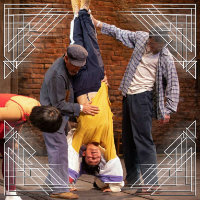
Yet another collection of short plays to include a contribution from the ubiquitous Tom Wells, this is a one-day event playing a total of two performances only, and commissioned by the Royal Court as one of a number of companion pieces to their main-house show The Mistress Contract. Inspired by that piece's unorthodox relationship, five writers have been asked to come up with something on the theme of Unusual Unions, and each one of them has contributed, in my opinion, something far superior to the main event. The way this promenade show works is actually very similar to I Do: The audience is colour-coded into "teams," who are led round the building to various areas, so the order anyone saw the plays in is fairly arbitrary and varies from group to group. So, as part of the green team Phill, Andy and I started by being taken to an unused Downstairs dressing room, for Rebecca Lenkiewicz's Anhedonia, directed by Simon Godwin. We meet a girl (Rona Morison) wearing a hijab, although not for the reasons we might expect. A violent incident has left her in a very dark place and interestingly, in contrast to the dramatic cliche, her encounter with the friendly foreman (Nathan Osgood) of a building site she's walked into doesn't leave her in a good place exactly, but it does make her that one step closer to coping. The subtle use of changing pronouns is a clever way of showing how the story develops in Lenkiewicz's powerful little piece.
Monday, 14 October 2013

Theatre review: The World of Extreme Happiness

Given its ever-increasing position on the world stage, it's not surprising if China has been a popular theme on the London stage lately. An American play getting its UK debut at The Shed, Frances Ya-Chu Cowhig's The World of Extreme Happiness looks at life for workers in the factories that make over 75% of the world's consumables, but also reveals a two-tier class system that's not so familiar in the West. The distinction is between those born in the city and those still known as peasants, from the country. Sunny (Katie Leung) is a country girl who's been denied an education by her father, as it's too expensive to be wasted on a girl. She moves to a city where she cleans toilets in a toy factory and, spurred on by a culture of self-help slogans, is determined to better herself - so much so that the factory owners see her as the perfect spokesperson for how far their peasant workers progress.