Pages

Showing posts with label Simon Daw. Show all posts

Saturday, 6 June 2026

Theatre review: Black Comedy

1960s British farces rarely get revived these days, generally because they're built on attitudes and situations that haven't exactly aged well (with the exception of What The Butler Saw, which gets away with it because how horrible those attitudes and situations are is basically the whole point.) But back when I was in school our drama club did a scene from Peter Shaffer's Black Comedy so - about as long after that performance as it was from the play's 1965 debut - I gave the Orange Tree's revival a chance in what I had originally planned to be a weekend of Shaffer, pairing it with his more famous Equus. This is a much less violent affair, other than in the slapstick sense: The high concept is that the play begins in what the audience sees as complete darkness, but in which the characters can see perfectly well.

Saturday, 9 March 2024

Theatre review: Uncle Vanya

Mere months since Chekhov's Vanya last graced a London stage he's back, although this time he's brought the rest of the cast with him too. With Trevor Nunn both adapting and directing this version of Uncle Vanya it's not particularly surprising if it's a bit more traditional - Simon Daw's designs definitely take us to late 19th century rural Russia, and you bet there's a samovar in pride of place centre stage. But Nunn isn't just ticking another classic off his list or indulging in a bout of nostalgia, as the Orange Tree production has elements that give it its own personality. Not least of all in tone: One of Chekhov's bleaker plays, it wasn't even questionably billed as a comedy like many of them, but the blurb here calls it a tragicomedy, and that's something it pulls off. The setting is the country estate that once belonged to Vanya's sister, purchased as a dowry for when she married a St Petersburg academic.

Saturday, 26 November 2022

Theatre review: Arms and the Man
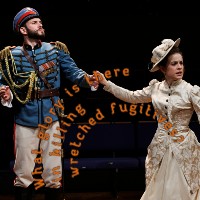
Paul Miller directs his final show as Artistic Director of the Orange Tree, and it's no real surprise that it involves one of the two classic playwrights who've kept the wolves from the venue's door during his tenure. I would have personally preferred a Rattigan swansong, but Miller's gone instead for Bernard Shaw: Arms and the Man is one of Shaw's most famous titles, although I don't think I've had the opportunity to see it before, so like most of the two writers' works presented in Richmond, it's presumably fallen out of favour and been forgotten. It turns out to be a lightly farcical romantic comedy for the holiday season, and less overtly political than its title and premise might have suggested: Set in rural Bulgaria during one of the endless 19th century conflicts between the Russian and Austrian empires, the Bulgarian army (under the Russians) have just scored a major victory over the Serbians (under the Austrians.)

Saturday, 14 December 2019

Theatre review: Candida

I'm not sure there's much at the moment that can't set off depressing thoughts on the current political situation, but walking into the Orange Tree to see the question "why are so many living in poverty?" as part of Simon Daw's set when, 120 years after Bernard Shaw's Candida premiered, the nation's official answer remains a resolute "who cares?" definitely has to qualify. The writings on the wall come from the Fabian Society, the influential Socialist group of which Shaw was a member, as is his character the Rev. James Morrell (Martin Hutson.) James is a much sought-after speaker who uses his day-job as a minister to drive home the similarity between Christian and Socialist values; he works tirelessly with support from his wife Candida (Claire Lams,) and practises what he preaches - some months earlier the couple helped a teenager they found sleeping rough on the Embankment.

Saturday, 24 March 2018

Theatre review: Humble Boy

I didn't catch Charlotte Jones' Humble Boy when it premiered at the National in 2001, but I've heard it mentioned a lot since as one of the best-loved new plays of the time. Paul Miller now tests how well it's aged with a revival of this gentle tragicomedy with overt Hamlet allusions. Designer Simon Daw has gone all-out in transforming the Orange Tree's in-the-round stage into the garden of Flora Humble's (Belinda Lang) Cotswolds home. Her husband has just died and her son Felix (Jonathan Broadbent) has returned after a long absence to attend the funeral, only to disappear when he was meant to be giving the eulogy. Felix is a theoretical astrophysicist who's been trying to find a unifying theory of the cosmos. His attempts to examine his inner life have been as unsuccessful as those to examine black holes, and he arrives back at the family home still in a suicidal mood.

Saturday, 3 December 2016

Theatre review: Sheppey

I'd always thought of Somerset Maugham as a novelist and short story writer who'd also written the odd play, but it turns out in the early part of his career he was quite a prolific and successful playwright. He did give up the theatre for the last three decades of his life though, and 1933's Sheppey was his final play. It's a satirical, political comedy on issues that are sadly timeless, and starts in a barber's shop where Sheppey (John Ramm) is assistant to Mr Bradley (Geff Francis.) His sense of humour makes him popular with the customers and his ability to sell Bradley's various potions to pretty much anyone is legendary. He's always said he was born lucky and it's proven when he wins the £8,500 jackpot in the sweepstakes. But this financial fortune comes at the same time as a health scare, and when he recovers from what might have been a mini-stroke, he's significantly changed his mind about what to do with the money.

Saturday, 21 May 2016

Theatre review: The Philanderer

Bernard Shaw's The Philanderer is set in and around a gentlemen's club with a difference: One that allows in both ladies and gentlemen, on the proviso that the women be approved as "un-womanly" and the men as "un-manly." It's Shaw's response to the scandalously independent women of Ibsen - the club is called The Ibsen Club - and sees its titular character use women's new wish for independence and equality to carry out his affairs without being expected to commit. Charteris (Rupert Young) is sort-of considering settling down with the widow Grace Tranfield (Helen Bradbury,) but first he needs to get rid of his other lover, Julia (Dorothea Myer-Bennett.) He tries to dump her, reminding her that she bought into a relationship where she could break it off at any time so the same applies to him. When that doesn't work, he tries to marry her off to another of her suitors instead.

Friday, 25 October 2013

Theatre review: Two

The title of Jim Cartwright's Two refers to the number of people in the cast, one man and one woman playing, between them, everyone who goes into a small local pub in the course of an evening. So the fact that the new production at Southwark Playhouse features four people on stage may seem paradoxical. But this is the latest show from Deafinitely Theatre, the deaf and hearing-impaired company that performs in both English and British Sign Language, and hopes to appeal to both a deaf and hearing audience. So Andrew Muir's production gives Cartwright's play a new conceit: Matthew Gurney and Paula Garfield play the landlord and landlady, Sophie Stone and Jim Fish all the customers. The former pair communicate entirely in BSL, with the latter speaking an English translation. And for the scenes with the customers, the situation is reversed.

Saturday, 6 October 2012

Theatre review: Tanika's Journey

Deafinitely Theatre were one of the companies contributing to this year's Globe to Globe festival, bringing their British Sign Language storytelling to Love's Labour's Lost. As one of Shakespeare's more verbally dexterous plays I found that silent treatment to have mixed results, but now in a new production at Southwark Playhouse' Vault they present a simpler story, devised by the company. A group of refugees is trudging through a frozen Russian forest. Exhausted, deaf Tamil refugee Tanika (Nadia Nadarajah) collapses in the snow, refusing her guide's (Graeme Brookes) attempts to give her food. As she appears to have given up, she flashes back to her earlier life in Sri Lanka with her family (Mouna Albakry, Arun Welandawe-Prematilleke) and English BSL teacher Edward (Matthew Gurney) who convinces her she needs to try and flee to London; as well as slipping into fantasies of her future life should she finally manage to complete her journey.