Writing down what I think about theatre I've seen in That London, whether I've been asked to or not.
Showing posts with label Leah Harvey. Show all posts
Thursday, 12 January 2023
Theatre review: As You Like It (@sohoplace)
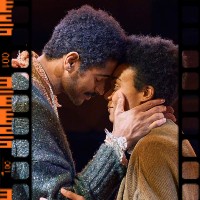
Back to @sohoplace Theatre, the venue with a name so current it has a pretty solid strategy in place for the Y2K bug, and it gets its first Shakespeare production in Josie Rourke's autumnal As You Like It. Opening with a song from Martha Plimpton's Jaques, it sets the tone for a production that largely reflects that character's melancholy worldview. Rosalind (Leah Harvey) and her cousin Celia (Rose Ayling-Ellis) leave the court they grew up in after a coup by Celia's father, and go to the forest of Arden in search of Rosalind's father, the banished rightful Duke. But before they leave Rosalind's just had time to meet and fall in love at first sight with Orlando (Alfred Enoch,) a dispossessed noble who's also just been banished. By the time they meet up again in the forest Rosalind has disguised herself as a man, and instead of coming clean comes up with a convoluted plan to test his love, because while this may be my favourite Shakespeare comedy honestly he's just throwing plots at the stage to see what sticks.
Tuesday, 27 September 2022
Theatre review: The Wonderful World of Dissocia
Anthony Neilson is certainly a playwright of extremes - I've seen plays of his that have ranged from horror to panto, occasionally within the same scene. Sometimes this is a response to mental illness, like Edward Gant's Amazing Feats of Loneliness, the surreal freak show he wrote as an antidote to a bout of depression. A play that deals even more directly with the theme is one I'd heard of but never had the chance to see before: The Wonderful World of Dissocia, which Emma Baggott revives at Stratford East. Lisa (Leah Harvey) has been feeling out of sorts for a while, and the reason is revealed when she tries to get her watch mended. Watch repairer Victor (Hollywood Body Double Leander Deeny) reveals that there's nothing wrong with the timepiece, it's Lisa who's an hour out of time: She was on a delayed plane when the clocks went back in October, and she never got back the hour she lost when they went forwards the previous March.
Tuesday, 14 May 2019
Theatre review: Small Island
This time last year Rufus Norris strayed out of his comfort zone for his big Olivier stage production with notoriously disastrous consequences, but he's back to much more familiar territory now for a big emotional, political epic that spans years, continents and clashing cultures. Helen Edmundson adapts Andrea Levy's Small Island, whose story about the Windrush generation has become topical again in recent years. Its three narrators are initially separated by an ocean, but chance and the Second World War will throw them together in life-changing ways: First up we meet Hortense (Leah Harvey,) a teacher in a remote Jamaican village whose romantic feelings about her cousin Michael (CJ Beckford) are crushed so abruptly it leaves her cold, spiky and pragmatic to the point of calculating; while she stays in Jamaica, Michael goes to England to join the war effort.
Saturday, 18 August 2018
Theatre review: Emilia
Like most new Artistic Directors, Michelle Terry's had a mixed first season in charge of the Globe, but one area that for me has seemed an unqualified success has been her approach to gender parity in casting. Although she's stuck to her predecessor's target of 50/50 casting, Terry has amended this to be across an entire season rather than on a production-by-production basis, so directors of individual shows don't feel too restricted by it. One way to make sure a lot of classics dominated by men can be balanced out is by having one production cast entirely with women, and Morgan Lloyd Malcolm's specially-commissioned Emilia is no random choice to get this treatment: The story of a possible muse of Shakespeare's bubbles over with anger at the absence of women from Jacobethan theatre, so the way Nicole Charles's production flips the era's all-male casting doesn't feel like meeting a quota, but like an essential part of the play's reclaiming of women's voices.
Tuesday, 23 January 2018
Theatre review: Yous Two
Chelsea Walker directs Georgia Christou’s debut play Downstairs at Hampstead Theatre, a short and entertaining look at co-dependency and the fear of hereditary mental illness. Yous Two are 15-year-old Billie (Shannon Tarbet,) and her father Jonny (Joseph Thompson,) who’ve been pretty much the only family each other has since Billie’s mother committed suicide, so long ago her daughter was too young to really remember her. Jonny struggles to work thanks to a shoulder injury from his last job, and makes ends meet as a ticket tout until the expected compensation payout arrives. Billie expects a more academic future – she’s a maths and science geek at school, and though she’s not as good at the humanities her more artistically-inclined best friend Rachel (Leah Harvey) helps her out with her English. The play takes place entirely in the bathroom (designed by Rosanna Vize) where Billie was born.
Thursday, 6 October 2016
Theatre review: The Tempest (Donmar King's Cross)
PREVIEW DISCLAIMER: I can't see any sign of the papers having been invited to this yet.
Phyllida Lloyd's all-female Shakespeare productions were announced as a trilogy, and the theme of "red hands" that ran through the other two plays made me think Macbeth might be the final bloody part. As it turns out Lloyd's idea was actually to do one tragedy - the original Julius Caesar - one history - the condensed Henry IV - and one comedy, which turns out to be The Tempest. As with the other two productions, the framing device is that Shakespeare's play is being staged by the inmates of a women's prison, a setting that would seem to lend itself better to the other two genres, but in fairness this is one of the comedies that's rarely actually funny. Instead the more accurate term of "late romance" would seem particularly appropriate here, as the prison story focuses even more on a character whose backstory has been becoming more prominent over the trilogy, and who of course is also the real-life company's big name: Hannah, the character Harriet Walter uses in the framing device, based on a real American lifer with no hope of parole.
Subscribe to:
Posts (Atom)


