Pages

Showing posts with label Sophie Russell. Show all posts

Sunday, 20 July 2025

Theatre review: The Merry Wives of Windsor (Shakespeare's Globe)

George Fouracres seems to be absolutely speeding his way through the big Shakespearean comic roles at the Globe, and has already got to Sir John Falstaff - the slightly alternate Merry Wives of Windsor version who tends to be portrayed as a bit fluffier than the manipulative old thief of the Henriad. Although maybe not so different in Sean Holmes' new take, which leans into the fact that, like many a later farce, this one also builds its embarrassments and misunderstandings on some pretty dark motivations. So Fouracres' Falstaff has to win the audience's sympathy through the humiliations he's put through - he's a bombastic bully who makes jokes about drowning puppies, and plots to seduce two married women less out of lust than malice: He'll enjoy humiliating their husbands by cuckolding them, and maybe burgle their houses as well while he's there.

Friday, 3 February 2023

Theatre review: Titus Andronicus
(Sam Wanamaker Playhouse)

Going into the Swanamaker's tenth year, creatives haven't yet got over the novelty of the candlelit playhouse and the idea of using it as a theme in their productions. Usually it's the unique way light and darkness work in there that provide the inspiration, but in Jude Christian's new production it's the physical candles and wax that take on a new significance. And the play is Titus Andronicus so that significance is, obviously, connected to death and maiming. In the first production I saw, Katy Stephens played Tamora, Titus' nemesis. In this all-female cast she gets to switch places to the title role: In this completely invented chapter of Shakespeare's Roman plays, Titus is a decorated general, most of whose 25 sons have died defending Rome. The remainder, as well as his sole daughter Lavinia (Georgia-Mae Myers) become collateral damage in a more personal battle, after he sacrifices the eldest son of defeated Goth queen Tamora (Kirsten Foster.)

Tuesday, 10 August 2021

Theatre review: Twelfth Night (Shakespeare's Globe)
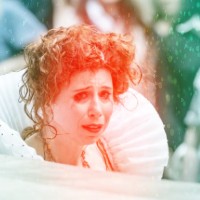
Without the new writing or more obscure revivals that sometimes take us into the autumn at Shakespeare's Globe, it's already time for my last outdoor visit of this summer season (there is one more show scheduled, but it's in the Swanamaker,) and it's the regular onstage appearance of the Artistic Director, as Michelle Terry takes on Viola in Twelfth Night. Shipwrecked on the coast of Illyria - here a scrapyard full of car parts, old neon signs, a jukebox and other clutter of 1950s Americana in Jean Chan's design - Viola makes a beeline for the local Duke, Orsino (Bryan Dick.) Disguised as a boy called Cesario, she falls for him immediately, but he's smitten with the unattainable, grieving Countess Olivia (Shona Babayemi.) When "Cesario" is sent as an envoy of Orsino's love to Olivia, the circle of unrequited love is completed when she's instantly attracted to "him."

Thursday, 10 June 2021

Re-review: A Midsummer Night's Dream (Shakespeare's Globe)

I have fond memories of, and emotional connections to, a lot of venues, but in the last year of theatres facing an existential crisis it was the thought of never being able to go to Shakespeare's Globe again that hurt the most. So it's probably for the best, given I might have got a bit emotional, that my first trip back to the main house in two summers was to a production I'd seen there before: Sean Holmes' fiesta-style A Midsummer Night's Dream from 2019 has returned to launch the 2021 season, and though both venue and production have had to make a few changes while COVID-19 restrictions are still in place, both have retained the atmosphere that makes them special. In the audience, along with social distancing in the three galleries, and all shows playing without intervals (to stop everyone crowding to the loos at once,) the most obvious change is in the Yard, where there's usually up to 700 standing groundlings. For the first couple of months of the season these have been replaced with just three rows of temporary seats arranged by support bubbles.

Wednesday, 20 November 2019

Theatre review: Richard III
(Sam Wanamaker Playhouse)

There's a lot of good actors about but not all of them have a Dick in them; Sophie Russell makes her own case as she continues in her role from Henry VI to play the deranged lead in Richard III. After the first play in this pairing I wondered if Ilinca Radulian and Sean Holmes would take a completely different tack with the Henriad's conclusion or follow right on from where they left off; the graffitied, muddy stage we open with immediately shows it's the latter, although as the play goes on it develops some new flourishes of its own. Playing Richard III as an immediate continuation of the Wars of the Roses has an effect on how Richard is played: The York family were happy to indulge Richard's psychotic side to do their dirty work, resulting in Edward IV (Sarah Amankwah) in power; their mistake was assuming that would be enough for him. Instead Richard wants the spoils for himself - so what if the only people left in his way are his own family?

Tuesday, 19 November 2019

Theatre review: Henry VI (Sam Wanamaker Playhouse)

The Globe's announcement that last winter's Richard II was the start of the complete Henriad cycle being performed on their stages this year was something to get excited about but also came with the inevitable problem for the company: The first tetralogy is full of popular hits but while the second ends on another crowd-pleaser in Richard III, the three Henry VI plays that precede it are a much harder sell. Peter Hall and John Barton's Wars of the Roses trilogy compressed them into two plays, and as it turns out the Globe Ensemble's way around the issue is even more drastic, chopping and changing them into a single three-and-a-half hour epic. In reality, and entirely unsurprisingly, if there is such a thing as a massive fan of Part One they should probably not get their hopes up - the fact that King Henry (Jonathan Broadbent) is already old enough to walk and talk as the play begins should be a clue that the largely unrelated prequel wouldn't figure, and we open with the introduction of the figure who will haunt the whole second tet, his queen Margaret (Steffan Donnelly.)

Sunday, 30 June 2019

Theatre review: Henry V, or Harry England (Shakespeare's Globe)

Now I'm not saying things in my day job have been a bit fraught lately, but there's been a lot of office discussions about the theory that sociopaths make the most natural and successful company directors. It's a thought you can't help but apply to one of England's best-loved kings when, as with the Globe Ensemble's Trilogy Day performances, the same company play Henry V following straight on from Henry IV Part One and Part Two. For those first two plays designer Jessica Worrall draped the theatre's middle gallery with the standards of many noble houses involved in the fighting, but now they've been replaced and it's just Henry's three golden lions that adorn the whole theatre; a sign that there's no more time for infighting and now everyone's together under one banner against a foreign foe? Or that it's now the Plantagenet way or the highway?

Theatre review: Henry IV Part Two, or Falstaff (Shakespeare's Globe)

"Fie, this is hot weather gentlemen."

Henry IV Part Two lacks the single clear antagonist of Part One, so instead the Globe Ensemble's renaming of the plays calls this one Falstaff, after the character who in this instalment finds out he grossly overestimated his importance to Prince Hal (Sarah Amankwah.) With the start time at 4pm this play occupies the hottest part of this Trilogy Day, and while the emotional depth of this part means it's frequently seen as superior to its predecessor, the story takes a while to get going which sometimes, especially in the first hour or so, gives the production the feel of Difficult Second Album Syndrome. But Federay Holmes and Sarah Bedi's production continues, as in Part One, to have scenes overlap, which keeps the energy up; with the multiple character doubling it also has the actors make a point of swapping roles onstage, nowhere more effectively than when Philip Arditti goes from Doll Tearsheet to Henry IV.

Theatre review: Henry IV Part One, or Hotspur (Shakespeare's Globe)

Michelle Terry's Globe Ensemble returns for a second year with a couple of returnees from last year's cast - including, of course, Terry herself. This time around their shows are a continuation from the winter season's Richard II in what is intended to be a year-long complete run through both of Shakespeare's History Tetralogies. Sarah Bedi and Federay Holmes direct a trio that takes us to the end of the First (in historical if not writing order) Tet, and which as well as regular performances are also getting a handful of Trilogy Days, following the characters (those of them who make it) throughout the reigns of Henry IV and Henry V. There's also been renaming of these three instalments to reflect who the Ensemble see as the central character of each piece, so we open with Henry IV Part One, now named Hotspur after the fiery rebel played by Terry.

Saturday, 18 August 2018

Theatre review: Emilia

Like most new Artistic Directors, Michelle Terry's had a mixed first season in charge of the Globe, but one area that for me has seemed an unqualified success has been her approach to gender parity in casting. Although she's stuck to her predecessor's target of 50/50 casting, Terry has amended this to be across an entire season rather than on a production-by-production basis, so directors of individual shows don't feel too restricted by it. One way to make sure a lot of classics dominated by men can be balanced out is by having one production cast entirely with women, and Morgan Lloyd Malcolm's specially-commissioned Emilia is no random choice to get this treatment: The story of a possible muse of Shakespeare's bubbles over with anger at the absence of women from Jacobethan theatre, so the way Nicole Charles's production flips the era's all-male casting doesn't feel like meeting a quota, but like an essential part of the play's reclaiming of women's voices.

Wednesday, 2 May 2018

Theatre review: The Prudes

The characters in writer-director Anthony Neilson’s The Prudes know they’re in a play called The Prudes, and they resent the implication somewhat – although Jess (Sophie Russell) thinks it might be fair in the sense that she doesn’t like the idea of dogging (she worries about the dogs being left alone while all the sex is going on and anyway, she doesn’t have a car.) But it’s true that she and her partner of nine years, James (Jonjo O’Neill,) haven’t had sex in 14 months, and they’re here to do something about it. Specifically, they’re here in Fly Davis’ chintzy pink boudoir set to have sex in front of a live audience. But first they need to introduce themselves and give some background to their relationship and its recent intimacy issues – basically, they need to keep talking about anything that’ll put off doing the act itself.

Tuesday, 16 September 2014

Theatre review: The Wolf From the Door

Revolution comes in the form of a black comedy fantasy in the first show of the Royal Court's new season, Rory Mullarkey's The Wolf From the Door. 25-year-old Leo (Calvin Demba) is jobless and homeless, but claims to be able to survive without eating, drinking, sleeping or sweating. When he meets eccentric aristocrat Lady Catherine at a train station and she takes him home, he assumes she wants him for sex, but her plans for him are much grander, and odder. Catherine (Anna Chancellor) is a leading light in an underground network of rebels and terrorists who've been meeting for months in innocuous-seeming groups to plot the overthrow of society. Discovering Leo, with his lack of apparent ties to that society, is the final piece of the puzzle, a figurehead for the revolution who will lead the country when the dust settles.

Friday, 1 August 2014

Theatre review: The Get Out

The Royal Court tends to have a bit of a siesta over August, but before it shuts up shop, three performances only of a sketch show that doesn't look anywhere near as hastily put-together as it actually is: Based on a project done as part of last year's Open Court, Anthony Neilson, who also directs, asked for submissions a few weeks ago for comic sketches, by anyone who'd ever worked at the Royal Court in any capacity. He and Robin French went through 50 submitted pieces and have compiled the best into The Get Out (unfortunately the cast-sheet doesn't list the writers who made the final cut.) Pippa Bennett-Warner, Imogen Doel, Nathaniel Martello-White, Jonjo O'Neill, Barnaby Power and Sophie Russell are the cast, and the framing device is an awards ceremony where some kind of disaster has reduced the venue to rubble, but everyone's still desperate to pick up a statuette.

Monday, 3 December 2012

Theatre review: Stories from an Invisible Town

Hugh Hughes, the mostly-fictional rising Welsh multimedia artist and alter-ego of actor/writer Shôn Dale-Jones, returns to the Pit with his fourth show following a national tour. (Dale-Jones claims to have been surprised after his first show, Floating, at people not realising Hugh wasn't real; but as his cast lists continue to credit the writing and acting to the characters, with the real creatives' names listed as "artistic associates," there's obviously a certain amount of deliberate blurring between him and his creation. It also makes crediting people in reviews tricky, so any crediting that follows is, I think, right, but comes mainly from a fair amount of googling.) This time around, for Stories from an Invisible Town, Hugh has been given siblings, Delyth (Sophie Russell) and Derwyn (Andrew Pembrooke,) who join him on stage for a loosely-structured memory play about their childhoods in Anglesey, and their more fractured relationships as adults.