Tonight it's Harry Potter and the Cursed Child Part Two, and as with Part One of J.K Rowling, Jack Thorne and John Tiffany's story I'm going to to do a review with some degree of spoilers, a little bit spoilery for plot, a bit more so for characters and staging, as a record of my reaction for myself if nothing else. So read on if you've seen the plays already or are involved in the production and already know everything; or, I guess, if you're absolutely sure you have no intention of ever seeing it either at the Palace or when it eventually opens on Broadway and, probably, territories all around the world. If you have tickets, are planning on going to see it or there's any chance you might some day, #KeepTheSecrets and stop reading after this paragraph.
Writing down what I think about theatre I've seen in That London, whether I've been asked to or not.
Showing posts with label Alex Price. Show all posts
Friday, 5 August 2016
Theatre review: Harry Potter and the Cursed Child Part Two
Labels:
Alex Price,
Anthony Boyle,
Christine Jones,
Imogen Heap,
J.K. Rowling,
Jack Thorne,
Jamie Parker,
John Tiffany,
Katrina Lindsay,
Noma Dumezweni,
Paul Bentall,
Paul Thornley,
Sam Clemmett,
Steven Hoggett
Thursday, 4 August 2016
Theatre review: Harry Potter and the Cursed Child Part One
Shows are always plugging themselves as "the theatrical event of the year"- most recently Sunset Boulevard attempted the line, rather foolishly as if there's ever been a year when that title has had no contest, this is it: Harry Potter and the Cursed Child Parts One and Two were a phenomenon as soon as tickets went on sale, and now the show's actually opened the response has actually lived up to expectations. Playwright Jack Thorne is the first writer J.K. Rowling has entrusted to script an entirely new, canonical Harry Potter story, although she and director John Tiffany collaborated with Thorne on putting the story together. I chose to see this over consecutive nights so will review the parts separately too, although reviewing a show where it's important to #KeepTheSecrets is a tricky business. Ultimately this blog is a record for myself as well as reviews for others, so I will be giving it a go - so here's a little spoiler disclaimer:
After the text cut, expect some spoilers - I'll be mentioning some characters and their actors, and the general starting point of the plot, but I won't give away all the twists. Still, if you have any intention of seeing this show, I'd say - spoilering this review itself - I loved it, now don't read below the cut. Even if you won't be seeing it until 2017 or even until it makes it to Broadway, come back and read what I thought then - I can wait.
Thursday, 4 December 2014
Theatre review: 3 Winters
As we reach Nicholas Hytner's final months running the National, a number of the most successful creatives from the last few years of his reign feature heavily. Howard Davies has been most closely associated with directing Russian classics on the Lyttelton stage, and though his latest production is a new Croatian play, it feels very much part of this ongoing series. In part it comes down to the set, this time provided by Tim Hatley: These shows have been noted for their audacious scene changes, and they're not only present and correct but a vital component of Tena Štivičić’s 3 Winters. This is because the winters in the story occur decades apart in the same house, and to the same family. In 1945, as the Communists take over, they evict the old royalist families. Rose (Jo Herbert,) her husband Alexander (Alex Price in 1945, James Laurenson in 1990) and their baby daughter Masha are allocated a large room in the mansion where Rose's mother Monika (Josie Walker) was once a servant.
Labels:
Adrian Rawlins,
Alex Jordan,
Alex Price,
Daniel Flynn,
Gerald Kyd,
Hermione Gulliford,
Howard Davies,
James Laurenson,
Jo Herbert,
Jodie McNee,
Lucy Black,
Sophie Rundle,
Susan Engel,
Tena Štivičić,
Tim Hatley
Monday, 14 April 2014
Theatre review: Birdland
Simon Stephens and Andrew Scott have previously collaborated to devastating effect on Sea Wall. Playwright and actor now reunite as Stephens writes a full-length play for Scott to star in, headlining Birdland as an international rock star called Paul (I did keep wondering if the character's name was a reference to Scott having played Paul McCartney in the past.) Paul is nearing the end of his second world tour, and his biggest yet. He's accompanied by his best friend and co-songwriter Johnny (Alex Price,) the one real link to his life pre-fame. But on the Russian leg of the tour Paul sleeps with Johnny's girlfriend Marnie (Yolanda Kettle,) who kills herself soon afterwards. With his friend no longer in a mental state to anchor him, Paul heads towards the home leg of the tour with his sanity steadily unraveling.
Thursday, 4 April 2013
Theatre review: Before the Party
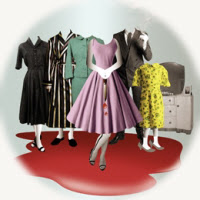
The scene is set a couple of years after the War, and food rationing is still in place, leaving the more privileged classes a bit tetchy about their lack of options for dinner. But the Skinner family will soon find plenty more to worry about in Rodney Ackland's Before the Party, which Matthew Dunster revives at the Almeida. Anna Fleischle's set is framed as a 1940s cinema (a conceit extended to the ushers' outfits,) a nod to the salacious movies lawyer Aubrey Skinner (Michael Thomas) disapproves of, filled with stories of crimes of passion the likes of which are about to be reenacted in his own country home as the screen pulls back to reveal the bedroom of his eldest daughter, the recently-widowed Laura (Katherine Parkinson.) Less than a year after her husband's death she's planning to remarry, to David (Alex Price,) two years her junior and with no apparent financial prospects.
Thursday, 1 March 2012
Theatre review: Bingo - Scenes of Money and Death
I'm wary, to say the least, of Edward Bond plays ever since Saved triggered a genuine depression attack a few months ago. But tonight's trip to the theatre had been booked for ages, and Vanessa's tendency to fancy older men extends to Patrick Stewart, so I braved Bingo with her. William Shakespeare didn't spend the end of his life writing and performing, but increasing his wealth back in Stratford-upon-Avon through money-lending and land. Taking this, and the fact that his relationship with his family appears to have been poor, as inspiration, Bond imagines the playwright's last days as a very dark, despair-filled time. We start with the Enclosures Act which will evict many of the local poor but which landowner Combe (Matthew Marsh) convinces Shakespeare to turn a blind eye to by promising to make up any loss of earnings from reduced rent. So despite his reservations, Shakespeare fails to support the poor and so has a measure of guilt for the unrest that comes later. His lack of action also has tragic consequences for a girl (Michelle Tate) who comes begging to New Place.
Bingo is subtitled Scenes of Money and Death and this is very much what we get over the next couple of hours, seen through the eyes of a man whom Stewart gives a very recognisable depression which makes him empathise with those in trouble yet unwilling to do anything to help. Meanwhile he's casually unkind to unloved daughter Judith (Catherine Cusack) while the ill Anne Hathaway is never even seen. Fortunately even if it accurately depicts depression, I didn't find myself in any risk of feeling suicidal this time, but it remains a very dark experience. Stewart's surrounded by a strong cast including the wonderful Ellie Haddington as his housekeeper and Alex Price as her angry son, while Richard McCabe's all-too-short appearance as a bombastic Ben Jonson brings some welcome, if dark humour to the piece. I found what ultimate point Bond is trying to make elusive, which makes the relentless misery harder to take. But director Angus Jackson and designer Robert Innes Hopkins undeniably create some gorgeous imagery on the thrust stage, most notably when Shakespeare is given his own version of Lear's most iconic scene: The madness replaced by drunkenness, the rain by snow, it's also the play's best and most moving scene.
Bingo - Scenes of Money and Death by Edward Bond is booking until the 31st of March at the Young Vic.
Running time: 2 hours 25 minutes including interval.
Bingo is subtitled Scenes of Money and Death and this is very much what we get over the next couple of hours, seen through the eyes of a man whom Stewart gives a very recognisable depression which makes him empathise with those in trouble yet unwilling to do anything to help. Meanwhile he's casually unkind to unloved daughter Judith (Catherine Cusack) while the ill Anne Hathaway is never even seen. Fortunately even if it accurately depicts depression, I didn't find myself in any risk of feeling suicidal this time, but it remains a very dark experience. Stewart's surrounded by a strong cast including the wonderful Ellie Haddington as his housekeeper and Alex Price as her angry son, while Richard McCabe's all-too-short appearance as a bombastic Ben Jonson brings some welcome, if dark humour to the piece. I found what ultimate point Bond is trying to make elusive, which makes the relentless misery harder to take. But director Angus Jackson and designer Robert Innes Hopkins undeniably create some gorgeous imagery on the thrust stage, most notably when Shakespeare is given his own version of Lear's most iconic scene: The madness replaced by drunkenness, the rain by snow, it's also the play's best and most moving scene.
Bingo - Scenes of Money and Death by Edward Bond is booking until the 31st of March at the Young Vic.
Running time: 2 hours 25 minutes including interval.
Subscribe to:
Posts (Atom)


