Dominic Dromgoole’s Classic Spring company was set up to present late 19th and early 20th century classics in the West End proscenium arch theatres they were written for, the suggestion being that’s something of a unique opportunity. While that might have been the case with some of the more obscure plays that opened the Oscar Wilde season, the concluding part is The Importance of Being Earnest, whose last West End revival wasn’t only three years ago, but in the same theatre, the Vaudeville. At the time I said the twenty-year gap I’d left since last seeing the play was probably about right given its ubiquity and familiarity, and I hadn’t been planning to return for this version. But the combination of Michael Fentiman directing and Sophie Thompson reclaiming the role of Lady Bracknell for actual female actors was tempting, and with a quiet August week on the horizon I decided to fill a spare evening seeing if some well-worn bon mots could feel fresh.
Writing down what I think about theatre I've seen in That London, whether I've been asked to or not.
Showing posts with label Stella Gonet. Show all posts
Wednesday, 29 August 2018
Tuesday, 12 September 2017
Theatre review: Doubt, a Parable
The Catholic Church is famous for its choirboy-abusing priests, but a lesser-known fact is that there’s also a system of religious beliefs attached to it. John Patrick Shanley’s Doubt, a Parable uses the former to look into questions of the latter, in a story set in a New York convent school in 1964. Headmistress Sister Aloysius (Stella Gonet) is a stern disciplinarian who’s fiercely opposed to change, ball-point pens, the song “Frosty the Snowman,” and either teachers or students actually enjoying their lessons. Her mission to crush all the joy out of young teacher Sister James (Clare Latham) has to be interrupted as she needs her help to investigate the school priest Father Flynn (Jonathan Chambers,) whom she suspects of taking an inappropriate interest in the pupils. The school has just taken on its first-ever black student, and Flynn seems keen to get particularly close to him.
Tuesday, 24 May 2016
Theatre review: Human Animals
Playwright Stef Smith takes the metaphorical language of dangerous animals and swarms of insects that accompany right-wing scaremongering about immigration, and imagines it as something literal in her apocalyptic Human Animals, but somewhere along the way the dark absurdity turns tiresome: Nancy (Stella Gonet) is waiting for her daughter Alex (Natalie Dew) to come back from a gap year, but her return coincides with a mysterious, localised plague among animals and birds that sees hundreds of pigeons at a time fly into windows, and dead foxes piling up in every garden. Nancy's friend John (Ian Gelder) is befriended by an odd man in the pub - Si (Sargon Yelda) turns out to be in charge of the efforts to deal with the crisis, which largely consist of quarantining the whole neighbourhood and incinerating first the diseased animals, then whole buildings, just in case.
Tuesday, 17 November 2015
Theatre review: A Further Education
A shaky start could resolve itself in great things or a complete nosedive; true of
many people's first year at university, and of Will Mortimer's debut play about a
mature student, A Further Education. At an unnamed (more on this later)
university, new tutor Chris (Oliver Hembrough) has three first year students in his
tutorial group. Straight out of school are Lydia (Isabella Laughland) and Joshua
(Makir Ahmed,) while Charlotte (Stella Gonet) is a local, much older but sharper
than any of them when it comes to dissecting the classics. Her grades are high and
her fellow-students quickly accept her in their social circle as well, and she even
ends up becoming friendly with the strident but scatty new Vice-Chancellor Rachel
(Issy van Randwyck.) There's more than just her age and the breadth of her knowledge
that sets Charlotte apart from the rest of the students though, and Joshua and Lydia
soon stumble upon a secret about her.
Monday, 8 December 2014
Theatre review: Hope
The Royal Court's Christmas shows tend not to be like other theatres' Christmas shows, and while for the second year running the creative team is writer Jack Thorne and director John Tiffany, this year's offering makes vampires seem positively festive in comparison. Hope follows the year 2014 in the life of the Labour council of an unnamed, working class town (everyone in the cast keeps their own accent, so it could be pretty much anywhere.) The actual business of running the town doesn't get a look-in though, as the Government's austerity measures have seen their budget slashed by £22 million a year, and everyone's primary concern is to determine which essential services have to be cut. Thorne's play identifies Government policy as a cynically genius plan: Slash budgets from the top but leave the details, and all the resulting ill-feeling, to the local, opposition councils.
Wednesday, 2 October 2013
Theatre review: Handbagged
It has the misfortune of looking like it's piggy-backing on The Audience (and in fact was almost shelved when that play was announced) but Handbagged actually predates it: Moira Buffini's play started life as an installment of the Tricycle's Women, Power and Politics in 2010.
When that show's director, Indhu Rubasingham, became Artistic Director of the venue, she commissioned a full-length version of the battle of wills between Britain's two most powerful women of the 1980s, the Queen and Margaret Thatcher. The setup remains as eccentric as before: A pairing of the two women in more recent years, Q (Marion Bailey) and T (Stella Gonet) introduce the meetings - primarily at the weekly audience Peter Morgan's play revolved around - between their younger selves Liz (Clare Holman) and Mags (Fenella Woolgar.)
When that show's director, Indhu Rubasingham, became Artistic Director of the venue, she commissioned a full-length version of the battle of wills between Britain's two most powerful women of the 1980s, the Queen and Margaret Thatcher. The setup remains as eccentric as before: A pairing of the two women in more recent years, Q (Marion Bailey) and T (Stella Gonet) introduce the meetings - primarily at the weekly audience Peter Morgan's play revolved around - between their younger selves Liz (Clare Holman) and Mags (Fenella Woolgar.)Thursday, 4 April 2013
Theatre review: Before the Party
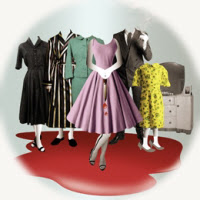
The scene is set a couple of years after the War, and food rationing is still in place, leaving the more privileged classes a bit tetchy about their lack of options for dinner. But the Skinner family will soon find plenty more to worry about in Rodney Ackland's Before the Party, which Matthew Dunster revives at the Almeida. Anna Fleischle's set is framed as a 1940s cinema (a conceit extended to the ushers' outfits,) a nod to the salacious movies lawyer Aubrey Skinner (Michael Thomas) disapproves of, filled with stories of crimes of passion the likes of which are about to be reenacted in his own country home as the screen pulls back to reveal the bedroom of his eldest daughter, the recently-widowed Laura (Katherine Parkinson.) Less than a year after her husband's death she's planning to remarry, to David (Alex Price,) two years her junior and with no apparent financial prospects.
Subscribe to:
Posts (Atom)


