Perhaps inspired by August Wilson's Century Cycle of plays exploring the
African-American experience, playwright Suzan-Lori Parks has created her own epic
sequence, Father Comes Home From The Wars, that looks at the legacy of
slavery in America. It's a series of nine plays following a single family down the
centuries, and the Royal Court here presents Jo Bonney's original Off-Broadway
production of the first three in the sequence, with a largely British cast. These
three sections of the story take place during the American Civil War, and the
central figure is the dubiously-named Hero (Steve Toussaint,) whose master has
promised him his freedom if he serves with him in the Confederate Army. Part 1 opens
as the other slaves wait for day to break, taking bets on whether Hero will decide
to stay or go.
Writing down what I think about theatre I've seen in That London, whether I've been asked to or not.
Showing posts with label Tom Bateman. Show all posts
Monday, 26 September 2016
Friday, 27 November 2015
Theatre review: Harlequinade and All On Her Own
When life gives you harlequins, make...
Harlequinade has a reputation as a very minor part of the Terence Rattigan canon. It's certainly not notable for its depth, but it's no doubt also suffered from often being paired with one of the playwright's masterpieces, The Browning Version, for no other reason than their both being one-acters. Playing in rep with The Winter's Tale in the SirKenBranCo season, it's paired with a different Rattigan piece, but it's no less of an unusual combination: The evening opens with Zoë Wanamaker in the monologue All On Her Own as widow Rosemary, returning from a date to an empty house. Sitting in the room where her husband died of an overdose, she has a conversation with him about whether it truly was an accident as the coroner ruled, or a suicide; she replies to herself on his behalf, expressing thoughts she's been afraid to say out loud before.
Friday, 13 November 2015
Theatre review: The Winter's Tale (Kenneth Branagh Company at the Garrick Theatre)
The latest director to launch his own West End residency is Kenneth Branagh, and he promises to stick around until the end and not get distracted by a shiny thing this time. For the opener SirKenBran co-directs with Rob Ashford and stars as Leontes in Shakespeare's The Winter's Tale. Leontes is king of Sicilia, and lifelong best friends with the king of Bohemia, Polixenes (Hadley Fraser.) Until, that is, for no reason at all, he becomes convinced that Polixenes is having an affair with his wife Herminone (Miranda Raison) and that the baby the queen is pregnant with isn't his. By the time the oracle at Delphi confirms Hermione's innocence it's too late: His public accusation and humiliation of her has brought about deaths and divine retribution, and Leontes' misery can only be ended 16 years later, when his lost baby daughter Perdita (Pirate Jessie Buckley) is found in Bohemia.
Tuesday, 22 July 2014
Theatre review: Shakespeare in Love
Déjà vu at the Noël Coward Theatre, where six months after The Full Monty another screen-to-stage adaptation opens. Whether it'll fare any better is yet to be seen, but for now crowds seem keen to get in to Shakespeare in Love. Marc Norman and Tom Stoppard's film script has been adapted for the stage by Lee Hall, but the story is still one that places the world's best-loved playwright in a plot straight out of his own comedies: Will Shakespeare (Tom Bateman) is having writer's block after a few early successes, until he meets a new muse in noblewoman Viola De Lesseps (Lucy Briggs-Owen,) who's already madly in love with his poetry before she's even met him. But he's married, and she's about to be married off too, so it seems unlikely they'll be able to find a happy ending together.
Monday, 25 November 2013
Theatre review: Lizzie Siddal
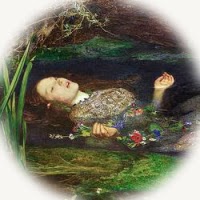
The Pre-Raphaelite equivalent of a supermodel, Elizabeth Siddal modeled for John Everett Millais' Ophelia, still the most popular painting at Tate Britain, and became muse to many artists of the Victorian movement. Jeremy Green's Lizzie Siddal looks at the life beyond the image, when Lizzie moved behind the canvas and attempted to become an artist in her own right. We first meet Lizzie (Emma West) posing for William Holman Hunt (a shamelessly scene-stealing Simon Darwen) and she later gets poached by Millais (James Northcote) for her most famous role, which almost proves fatal when the water goes cold and she contracts pneumonia. But her most enduring relationship, and one that could prove more destructive than any number of cold baths, will be with the artist and poet Dante Gabriel Rossetti.
Monday, 2 April 2012
Theatre review: The Duchess of Malfi
The Old Vic's baroque Duchess of Malfi is clearly not going to be the venue for another wedding disco, thus bucking the trend for Jacobean tragedy this year. Of course, the wedding in question being a closely-guarded secret (a secret that somehow survives several years and three children) the chances of the cast doing the "Tragedy" dance were always going to be slim. Instead Jamie Lloyd gives us an epic production of John Webster's best-known work, on Soutra Gilmour's sumptuous set of arches, walkways and candles. The Duchess of Malfi has recently been widowed, and her two brothers advise her not to remarry. Obeying them on the surface, she in fact secretly marries her young steward. When it all finally comes out, her brothers deal with the class-defying relationship in typically bloody fashion.
Subscribe to:
Posts (Atom)


