Writing down what I think about theatre I've seen in That London, whether I've been asked to or not.
Showing posts with label Alex Waldmann. Show all posts
Thursday, 5 March 2026
Theatre review: Broken Glass
After a wobbly start to the Young Vic's new regime - a Mr Sloane that bafflingly ironed the gay out of Joe Orton, and a Bengal Tiger that was just baffling in general - it settles into a stronger groove with Jordan Fein's take on Arthur Miller. The Broken Glass in his 1994 play is Kristallnacht, the 1938 attacks on Jewish businesses that became the first major sign of the extent to which Nazi Germany was willing to turn its antisemitic rhetoric into action. As stories and photos appear in the newspapers worldwide, New Yorker Sylvia Gellburg (Pearl Chanda) suddenly loses the ability to walk. Referred to Dr Hyman (Alex Waldmann,) he and the experts he consults with are unable to find a physical cause for her disability, and he starts to lean towards theories of something psychosomatic: Confronted with both these brutal images and everyone around her's seemingly blasé responses to them, part of Sylvia has shut down.
Thursday, 10 July 2025
Theatre review: Intimate Apparel
The ongoing collaboration between playwright Lynn Nottage and director Lynette Linton at the Donald and Margot Warehouse continues into a third artistic director's tenure, this time with a historical piece that trades overt anger for something simmering under a quiet heartbreak. Intimate Apparel takes place in 1905 New York where, however formidable and accomplished she might be on her own terms, a woman who's reached a certain age without getting married will still be in what seems like a hopeless situation. So Esther (Samira Wiley,) a seamstress who specialises in fashionably scandalous corsets, has sought-after skills and has spent the last eighteen years saving up the cash to open her own beauty parlour. But while dozens of single girls have passed through Mrs Dickson's (Nicola Hughes) boarding house in that time and left married, at 35 Esther remains single.
Saturday, 26 November 2022
Theatre review: Arms and the Man
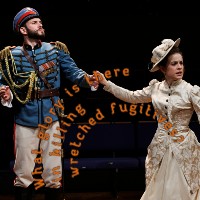
Paul Miller directs his final show as Artistic Director of the Orange Tree, and it's no real surprise that it involves one of the two classic playwrights who've kept the wolves from the venue's door during his tenure. I would have personally preferred a Rattigan swansong, but Miller's gone instead for Bernard Shaw: Arms and the Man is one of Shaw's most famous titles, although I don't think I've had the opportunity to see it before, so like most of the two writers' works presented in Richmond, it's presumably fallen out of favour and been forgotten. It turns out to be a lightly farcical romantic comedy for the holiday season, and less overtly political than its title and premise might have suggested: Set in rural Bulgaria during one of the endless 19th century conflicts between the Russian and Austrian empires, the Bulgarian army (under the Russians) have just scored a major victory over the Serbians (under the Austrians.)
Monday, 3 October 2022
Theatre review: Jews. In Their Own Words.
When the Royal Court announced Jonathan Freedland's Jews. In Their Own Words. as the opener for its autumn season, my brain autocorrected the title to Jews. Please Don't Boycott Us. After last year's antisemitism fiasco it was pretty obvious that this was an attempt at a mea culpa from the venue, and while there's definitely something to be said for not dragging their feet about addressing the issue, ten months since that happened seems a very quick turnaround for a theatre where scripts can percolate for years. (For anyone not up to speed: Rare Earth Mettle was meant to feature a shifty billionaire called Hershel Fink. Having seen the play, I'd say playwright Al Smith was probably going for something with the vague cadences of "Elon Musk," but he actually landed on a hugely stereotypical Jewish name, paired with an equally stereotypical moneybags character. When the play opened in previews and caused offence, the name was changed, but further controversy came with reports that some people had highlighted the connotations and been ignored.)
Monday, 4 April 2022
Theatre review: The Fever Syndrome
Hampstead Theatre may now be run by Roxana Silbert but some things don't change, and it remains London's main home for That American Play Where An Extended Family Gets Together After A Long Time, Preferably At Thanksgiving But That’s Optional. Silbert herself directs the latest iteration of a play every American playwright seems, for some reason, to be legally obligated to write and just change the character names. The twist is Alexis Zegerman isn't even American so The Fever Syndrome is... a tribute act maybe? It does tick every other box, including the ever-popular Asshole Genius add-on feature, as the excuse for bringing three siblings and their partners to the New York brownstone they grew up in is their father receiving a lifetime achievement award. Richard (Robert Lindsay) is an obstetrician and IVF pioneer, who still bears a grudge against the Republicans for delaying his research on religious grounds, meaning Britain beat America to the first test tube baby.
Saturday, 14 March 2020
Theatre review: The Mikvah Project
The Mikvah Project feels a bit of an unlikely play to get a major revival within a few years of its premiere, when I was interested but not entirely convinced by it. But I've got a certain reputation to live down to as far as plays with extensive male nudity go and besides, I wanted to know if a different perspective would make it feel a bit more focused than it seemed last time. And Georgia Green's production - her professional debut, following its appearance last year as part of an Orange Tree new directors' showcase - does go some way towards filling in some gaps. The Mikvah is a Jewish ritual bath, more commonly used by women, but there are ones available for men as well, like the pair in Josh Azouz' play who meet there every Friday for particular reasons of their own. 35-year-old Avi (Alex Waldmann) goes to pray for the child he and his wife are trying to conceive (or as he puts it, he's praying to his balls.)
Saturday, 6 May 2017
Theatre review: Julius Caesar (RSC / RST & Barbican)
It's ironic that Gregory Doran, to me the epitome of reverential, by-the-numbers Shakespeare, should have delivered my favourite-ever Julius Caesar a few years ago in a comparatively exciting and revelatory production; because Doran having temporarily handed over the reins to Angus Jackson for the Roman season at the RSC, it's Jackson who now serves up perhaps the most vanilla version of the same play I've seen so far. Have no doubt you can expect togas, swords and sandals from Robert Innes Hopkins' design as Julius Caesar (Andrew Woodall) returns to Rome triumphant after a military victory. His popularity sees the people clamour to give him political power at home, but not everyone's impressed: Cassius (Martin Hutson) has never been a favourite of Caesar's and doesn't want to wait and see how he'll fare under the new regime.
Wednesday, 10 February 2016
Theatre review: In the Night Time (Before the Sun Rises)
My ongoing attempts to see less theatre always seem to come up against snags; I'd
stopped myself from booking for In the Night Time (Before the Sun Rises) at
the Gate, as the blurb about a couple kept up all night by their baby didn't really
pique my interest. But then Alex Waldmann and Adelle Leonce were announced as the
couple and it suddenly seemed harder to skip. Their nameless couple are young, but
not so young they don't know what they're doing when they get together - they're a
good match and have a fun, stable relationship, living together for some years
although not getting married (he'd like to but she doesn't believe in it.) Even a
well-adjusted pair aren't a match for the strain put on them by a baby though, and
the two narrate the story of a particularly difficult night. Their immediate worries
about how well they can look after their daughter get swamped by larger ones about
the world they've brought her into.
Saturday, 17 October 2015
Theatre review: Richard III (The Wars of the Roses at the Rose Theatre, Kingston)
I don't know if it's John Barton's edit/adaptation or Trevor Nunn's direction (probably a bit of both,) but this trilogy version of The Wars of the Roses seems to be a lot less overtly Lancastrian in sympathy than Shakespeare's four-play original. Not that it's become Yorkist instead, but both sides of the conflict come off about equal in terms of culpability for the lives lost. Richard III is by far the most frequently performed play in the tet as it's considered something of a standalone story, but it definitely benefits in a couple of ways from being seen in context, and one of these is in a titular villain who isn't quite as villainous here: Robert Sheehan's Richard spent Edward IV as the Yorkist enforcer, doing the dirty work that'll get his family into power. Once they've got it, it turns out that the biggest obstacle to keeping it is the family themselves, so he proceeds to turn on them, killing both relatives and former allies.
Theatre review: Edward IV (The Wars of the Roses at the Rose Theatre, Kingston)
Henry VI's queen, Margaret of Anjou (Joely Richardson,) is a figure who looms over the whole of Shakespeare's second historical tetralogy - or in the case of John Barton's War of the Roses edit, trilogy. In Edward IV, the determination and strength she showed earlier in the sequence starts to reach a level of insanity that'll inform much of the climactic play as well. What kicks it off is a deal her husband (Alex Waldmann) makes in an attempt to pacify his Yorkist rivals: He will remain king to the end of his natural life, but the Duke of York (Alexander Hanson) and his sons will be his heirs. As this disinherits their son Edward (played by Freddy Carter's cheekbones,) Margaret won't stand for it; soon she's leading the charge herself, the treaty's forgotten and the wars are back on, bloodier than ever. York won't live to see the crown himself, but it will pass back and forth between Henry, and York's son Edward IV (KÃ¥re Conradi - for the sake of NUNNSTORICAL ACCURACY the king of England is Norwegian.)
Theatre review: Henry VI (The Wars of the Roses at the Rose Theatre, Kingston)
I don't know why, but I just get the impression that Trevor Nunn favours the white roses.
A Shakespearean epic in Kingston (Jamaica? No, she went of her own accord) as Trevor Nunn looks back at one of the most famous productions from the RSC's history - The Wars of the Roses. John Barton adapted the second tetralogy (first in order of writing) of Shakespeare's Histories into a trilogy, combining the three Henry VI plays into two, and topping off the event with Richard III. Nunn credits Peter Hall's original production with inspiring his own theatrical career, and so revives the sequence as a tribute both to him, and to Barton's editing work. The trilogy has been slightly overshadowed, deservedly, by controversy, as Nunn has deliberately eschewed colour-blind casting, claiming on the one hand that an all-white cast is more historically accurate, and on the other that audiences will find it easier to follow the complex family trees if all members of a family are the same race.
Tuesday, 9 June 2015
Theatre review: King John (Shakespeare's Globe & tour)
Following runs at Temple Church and in Northampton one of only two standalone Shakespeare histories, King John, finally makes it to Shakespeare's Globe. It's part of the Magna Carta-themed Justice & Mercy season, and James Dacre's production does drop in a reference to that most famous - and unwanted - legacy of the king, even if Shakespeare himself famously didn't. Instead we follow King John (Jo Stone-Fewings) from his (first) coronation to his death, a reign whose every battle, treaty or political machination seems to instantly flop when chance throws a spanner in the works - usually in the form of a smug Papal Envoy (Joseph Marcell,) who likes to pop up occasionally to remind the various princes that the Vatican trumps their authority. With candles, incense and chanting hooded figures dominating Jonathan Fensom's design from the start, it's clear this is a world where the Church is a presence that's not to be messed with.
Saturday, 8 November 2014
Theatre review: Jonah and Otto
We first meet ageing clergyman Otto (Peter Egan, from the 1980s,) hugging a wall, but he's not the most unpredictable character in Robert Holman's Jonah and Otto. Somewhere in a seaside town, Otto is accosted by Jonah (Alex Waldmann,) a younger man pushing his six-week-old daughter in a supermarket trolley, and trying to get money by variously begging, stealing, and performing magic tricks. Despite having only just met, the two men seem to have become quickly invested in each other, and are soon questioning each other on not only their life stories, but also their deepest thoughts on life itself. Holman is a writer whose work I approach with a fair amount of trepidation - I found Making Noise Quietly oppressively boring, but there were parts of Across Oka I thought worked beautifully. On the surface Jonah and Otto is as wilfully oblique as the former play, but in Tim Stark's production at least I found it much more successful.
Thursday, 27 February 2014
Theatre review: The Knight of the Burning Pestle
With The Duchess of Malfi, Shakespeare's Globe explored the possibilities for atmospheric lighting in their new candlelit venue. For the second full production in the Swanamaker, it's the dynamics of the space that are put to the test: Even more than the main house, the indoor playhouse feels as if the actors and audience are on top of each other, so what better way to exploit that than in a play that blurs the lines even further, Francis Beaumont's The Knight of the Burning Pestle. It seems post-modernism, despite the name, predates modernism, and was alive and well in the 17th century, when a Grocer (Phil Daniels) and his wife (Pauline McLynn) sit in the front row to watch a light romance called The London Merchant. But the pair have very specific ideas about what they'd like to see, and they go on go on go on go on go on go on go on go on go on to wreak havoc.
Thursday, 23 January 2014
Theatre review: The Duchess of Malfi
Shakespeare's Globe serves up a feast for the eyes and a torture for the back and buttocks as it finally unveils the new Sam Wanamaker Playhouse. The much smaller indoor companion to their summer theatre launches its first season with the best-known tragedy by Jacobean nutter John Webster, The Duchess of Malfi. The titular Duchess (Gemma Arterton) is a young widow, who secretly marries her steward Antonio (Alex Waldmann) and has three children with him without almost anybody noticing. The Duchess has a pair of psychotic brothers, her jealous twin Ferdinand (David Dawson,) who is inappropriately possessive of his sister's virtue, and the oily, hypocritical Cardinal (James Garnon.) When their spy Bosola (Sean Gilder) brings them news of their sister's secret life, they plot a cruel, brutal and, this being Webster, generally batshit fucking insane punishment.
Saturday, 17 August 2013
Theatre review: All's Well That Ends Well (RSC / RST & TR Newcastle)
The final play in the RSC's main house season this summer is a bona fide Problem Play - although just how problematic can vary from production to production of All's Well That Ends Well. Helena (Joanna Horton) is the daughter of a famous doctor, and when the King of France has an apparently incurable fistula she uses her late father's techniques to cure him. In return the King (Greg Hicks) promises her the hand of whichever man she wants. She chooses the man she's loved since childhood, the Count Bertram (Alex Waldmann.) But not only does the object of her affection see her as his social inferior, he doesn't even remotely find her attractive. Forced into a marriage, he refuses to consummate it and runs away to war, telling her he'll only consider them truly married if she can get from him the ring he never removes, and bear his child despite his refusal to have sex with her. Not the kind of girl to take a hint the size of an anvil, Helena interprets this as a challenge, and hatches a new plan that'll see her follow him to the battlefield.
Saturday, 13 July 2013
Theatre review: As You Like It (RSC / RST & TR Newcastle)
From a Shakespeare play that's new to me to one I'm very familiar with, As You Like It having been the first Shakespeare comedy I saw on stage in 1989, and the one that made me realise their humour can still work today. Accordingly it's also a play I can be very particular about, and have been known to get stroppy if I think it's been poorly served by the production. This year's RSC offering though comes with a promising pedigree: Maria Aberg directed my favourite Shakespeare of 2012, King John, and here she reunites with its leads, Pippa Nixon and Alex Waldmann, to take on Rosalind and Orlando. Rosalind's father, the Duke Senior, has been deposed and exiled by his younger brother Frederick. When she spots the mistreated young nobleman Orlando de Boys winning a wrestling match, he and Rosalind fall in love. Shortly afterwards they're banished, separately, to the forest, and by the time they meet again Rosalind is disguised as a boy - a subterfuge she now uses to test and toy with her lover.
Saturday, 23 March 2013
Theatre review: Hamlet (RSC / RST & TR Newcastle)
PREVIEW DISCLAIMER: This production invites the critics in next week.
Although I'd like to approach every show with no preconceptions, some productions are easier to get excited about than others. I like Hamlet, and the cast the RSC has assembled, enough to warrant a trip to Stratford-upon-Avon. But David Farr is one of the company's most prolific directors, and Jonathan Slinger has been an almost constant presence in Stratford for the last few years. It's hard not to feel as if the pair have been let loose on the "big one" having paid their dues, rather than because of any really exciting idea they wanted to explore. It's a feeling not helped by the fact that Slinger isn't an obvious match to the role at this point in his career - at 40 he's the oldest Hamlet I've seen, overtaking Simon Russell Beale who was 39 when he tackled the role. Having put my preconceptions on the table from the outset I will say that as the show approached I got more excited about it; the production photos revealed an interesting set by Jon Bausor, and the publicity suggested a particular focus on the fencing that gives the play its climax, and I was intrigued by how that conceit would work.
Saturday, 28 July 2012
Theatre review: A Soldier in Every Son - The Rise of the Aztecs
Playing a short run (but apparently not short enough - today's final matinee was only half full) as the third play in the RSC's "Nations At War" season in the Swan, Luis Mario Moncada's A Soldier in Every Son takes its title from a line in the Mexican National Anthem, and its story from the country's oral history. The ensemble from Richard III and King John are boosted by a handful of actors from Mexico's CompañÃa Nacional de Teatro, and Roxana Silbert directs. As the play opens in the late 14th century, three royal families each rule their own kingdom, power shifting and being maintained through diplomacy, the payment of tributes to each other, tactical marriages and, when all these fail, outbreaks of violence. Somewhere in the background lurk the Aztecs, a tribe of "savages" nobody sees as much of a serious threat.
Saturday, 14 July 2012
Theatre review: Richard III (RSC / Swan)
There's many legendary speeches in Shakespeare, which must be nerve-wracking for any actor. Most of them turn up well into the play, and clever choices by directors and actors can even sometimes make them take you by surprise. But Richard III's most famous line, "Now is the winter of our discontent Made glorious summer by this son of York" is the play's very first, so as the lead actor enters, much of the audience will be wondering how he'll deliver it. Some might even know the speech so well they find themselves muttering it under their breath, like a woman in the front row of the Swan did today. A few lines into the speech Jonjo O'Neill turned, smiled at her and said "Yes, that's it. You know it?" It set the tone for what kind of Richard we were in for: Having done his time as a member of the EnsembleTM, O'Neill returns to the RSC as the star turn, to play the Duke of Gloucester as the consummate actor, playing to and flirting with the crowd.
Subscribe to:
Posts (Atom)


